Russ Granata
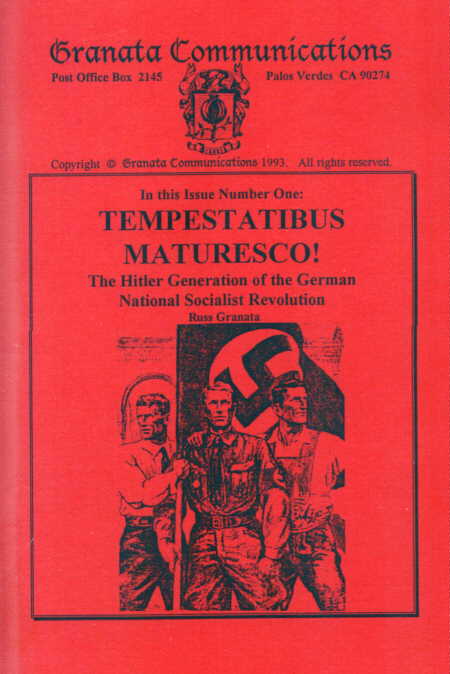 In his work entitled
TEMPESTATIBUS MATURESCO: The Hitler Generation of the German National
Socialist Revolution, Russ Granata wrote: "I am the great grandchild of an idealistic, a grandchild
of a romantic, and a son of a materialistic generation." These are the words of Ernst
Jünger, born in 1895, who exemplifies the generation which became that of the
twentieth century German National Socialist Revolution; the Hitler generation which
spawned that uncommon leader from the Common Man.
In his work entitled
TEMPESTATIBUS MATURESCO: The Hitler Generation of the German National
Socialist Revolution, Russ Granata wrote: "I am the great grandchild of an idealistic, a grandchild
of a romantic, and a son of a materialistic generation." These are the words of Ernst
Jünger, born in 1895, who exemplifies the generation which became that of the
twentieth century German National Socialist Revolution; the Hitler generation which
spawned that uncommon leader from the Common Man.
This was that biological generation which experienced the conflicts of 1914 and 1939,
those two phases of which Georg Franz-Willing, citing Churchill's pronouncements,
likens to a second Thirty Years War within a tragedy of the West.
This generation grew up before World War I in an era of apparent security, but of great
materialistic changes, and then revolted against "the system" which was perceived as
unwanted domination over the majority by an alien, international plutocratic minority.
The German National Socialist Revolution grew out of an extended malaise of what was
perceived as Folk-threatening dysgenic universalism, degeneracy, money slavery,
and the mass impersonalization of modern life, as well as to revise Versailles.
It was, and remains, an ideological revolution interrupted by World War II.
The strata of participants was not delineated, resulting in a broad supportive spectrum
of the population in Germany and elsewhere; not only from the masses, but also from
Zionists, some non Aryans and Mischlinge (cross-breeds) who concurred with aspects
of the National Socialist program, both before and after the eventual race defining
citizenship laws and geneological identification papers. These revolutionaries
considered themselves radical, meaning basic reformers. They crowned Der Arbeiter
(the worker). The elevated and respected worker with his spade at his shoulder marched
gloriously as the soldier, and the worker became to include the intellectual who works
with his brain, as well as the worker who labors with his brawn. All would be paid by
new Marks not backed by gold, but by the Germans' productivity.
Across all ranks a consortium was formed unifying liberals, socialists, national patriot
industrialists, farmers, and scientists, fused together into an intellectual and spiritual
Deutschtum or Folkish togetherness, and no matter whether they thought of themselves
as being on the "Right" or "Left", the one thing most of them had in common was a
strong nationalism.
They were the flowering from prior generations of "fathers" and "grandfathers" who
partook in earlier nationalistic times, although Georg Franz-Willing does show unique
aspects of the Hitler era in his definitive series on the Hitlerbewegung
(The Hitler Movement).
A harbinger had occurred in October of 1817, as Peter Gay states in describing what
he calls a famous scene from which nationalist and völkische (folkish) elements
derived much inspiration:
"Three hundred years after Martin Luther had nailed his theses to the church door at
Wittenberg, German students, wearing old-fashioned costumes, gathered at the
Wartburg, a historic and romantic spot; they shouted "Heil", sang patriotic songs,
said fervent prayers, and burned some books. They were at the Wartburg to celebrate
the liberation of their country--or, rather, countries--from the alien yoke, and in their
celebration they linked the reformer Luther with the general Blöcher as twin
liberators of the German spirit and the German land, determined to draw strength
from ancient myths for the political and moral tasks before them."