Technique and Operation of German Anti-Gas Shelters in World War II: A
Refutation of J. C. Pressac's "Criminal Traces"
by Samuel Crowell
"In
Memoriam!"
Revised 4/30/97, additional graphics 6/4/97
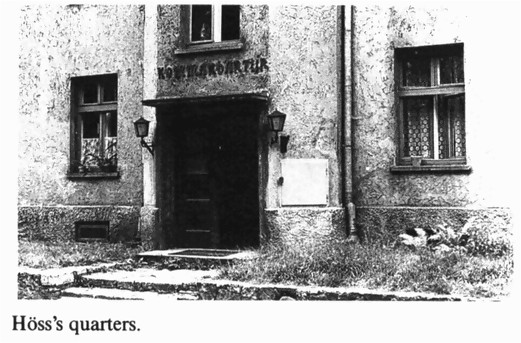
The personal residence of Auschwitz camp commander Rudolf Höß. Note
small gas-proof shutter (Blende) to the right of the
door.
It is well known that although poison gas was used extensively in World
War One, it was not used in World War Two. As a result, we tend to forget
that most people in the 1930's expected gas warfare to be a feature of any
future conflict. The German civil defense literature reflected the anxiety
of the time, describing in great detail how German bomb shelters were to
be made secure from both bombs and poison gas.
In other
words, German bomb shelters were also anti-gas shelters. [1]

Air-raid
shelter door on display at USHMM as a "gas chamber door"
While the German WWII literature on bomb shelters or anti-gas
shelters has been neglected, it is of enormous value to historians as a
primary source. It is particularly relevant for historians of the
Holocaust, because this literature contains all the terminology one
normally associates with the extermination gas chambers at
Auschwitz-Birkenau.
In 1989, a book appeared in English by
the Frenchman, Jean Claude Pressac, entitled, Auschwitz: Technique and
Operation of the Gas Chambers [hereinafter, ATO] Pressac sought to
prove, strictly on the basis of documentary materials, that extermination
gas chambers were built in each of the four crematoria at Birkenau. The
core of his demonstration was a list of 39 "criminal traces" for these gas
chambers. [2]
But there is something curious here: every one
of these criminal traces describes a feature of an ordinary German bomb
shelter. In other words, every trace taken as evidence of gas chambers can
also be interpreted as evidence of German bomb shelters or, more
precisely, their anti-gas warfare equipment.
It is
important to note that the similarity of extermination gas chambers and
bomb shelters is not exactly new, and to some extent is even suggested in
the Holocaust literature. [3] Among independent researchers, Friedrich
Berg was the first to recognize the importance of WWII German civil
defense literature, but his research interests lay elsewhere. Among a
handful of European researchers, Robert Faurisson made some suggestive
comments in an article a few years ago. [4] In August, 1996, an American,
Dr. Arthur R. Butz, made an important step forward when he argued on his
Northwestern University Internet homepage that Morgue #1 of Crematorium II
at Birkenau was in fact a "gas shelter." [5]
But while
there has been some talk of German bomb shelters, their anti-gas features
have been largely overlooked. The present article will redress this
imbalance, by drawing attention to the fact that anti-gas warfare features
were basic to German bomb shelter design. By pointing out these features,
we will also be highlighting this important literature. Finally, a
comparison of anti-gas shelter design and equipment with the criminal
traces of Jean Claude Pressac provides a fitting test of this literature's
value.
The present article comprises two parts, preceded by
a brief background on the subject of poison gas warfare. In Part One, we
shall describe a variety of German bomb shelter or anti-gas shelter
literature, which the interested scholar is strongly advised to consult.
We shall include several extracts, with complete extracts in the original
German in reduced type. We feel this level of detail is needed, not only
because of the importance of the literature, and its relative
inaccessibility, but because of the contentiousness of some possible
implications. After our review, we shall draw some conclusions about the
characteristics of German bomb shelters.
In Part Two, we
shall deal with each of Pressac's criminal traces, with reference to the
extracts from Part One, and some reference to the documents in Pressac's
book. We shall find that every trace can be interpreted in two ways:
either as the sinister hallmark of a homicidal gas chamber or as a benign
anti-gas warfare feature of a common German bomb shelter. The implications
of this fact are not negligible.
A Brief Background
on Poison Gas Warfare Prior to World War Two
Although it
is possible to trace the use of poisonous smokes to earlier times, it is
generally agreed that the era of poison gas warfare as we know it began on
April 22, 1915. [6] On that date, the Germans released a cloud of chlorine
gas on French positions at Ypres, achieving a breakthrough that they
failed to exploit. From that point on, both sides used poison gas, causing
hundreds of thousands of gas casualties, of which, however, only a small
percentage died.
The gases used were generally classed into
four groups, based on their properties.
1.
Lachrymators, or tear gases (White Cross, according to the German
system of classification). These were tear gases whose main purpose was
simply to encumber the enemy by forcing him to don his gas mask and
exhaust its protective capacity.
2. Sternutators, or
sneezing, coughing, and vomiting gases (Blue Cross), which were initially
designed to incapacitate the enemy, but which later were used to force the
enemy to remove his mask to vomit or sneeze and make himself vulnerable to
lethal gas.
3. Vesicants, or blister gases (Yellow
Cross), heavy, persistent aerosols which nullified the ground for either
side, and which would raise huge blisters on the skin of the enemy, which
could lead to permanent scarring. The actions of vesicants on the mucus
membranes of the throat and other internal membranes could be fatal, and
on the eyes could cause blindness. This class included the various mustard
gases, as well as Lewisite. Probably the most famous victim of this class
of gases was Adolf Hitler, whose temporary blinding in 1918 left him with
a lifelong hatred of poison gas, which is the reason Germany never used it
in World War Two. [Se 281-282, W 56f]
4. Lung
Irritants, or suffocating gases (Green Cross), a sort of catch-all
classification which included Chlorine as well as Phosgene, the last a
particularly dreaded gas because it could slowly fill the lungs of the
victim with fluid that could result in sudden death as much as 48 hours
after the attack. Phosgene was additionally classified as a lethal gas,
because of its potential effect, but there was only one gas known that
could be immediately lethal, and that was hydrocyanic acid [HCN], or
hydrogen cyanide gas.
Cyanide gas would seem an unlikely
candidate for poison gas warfare because of its diffusive properties. The
Germans never bothered to use it. Nevertheless, the British and French
developed cyanide compounds and used them against the Germans, usually in
shells comprising 50% HCN and the rest various chlorides. [EB 115] The
effectiveness of HCN in a tactical sense depended on gas mixtures.
For example, exposure to lachrymators or sternutators would either lull
the enemy, exhaust his gas mask's capacity, force him to remove it, or
cause him to use a different filter. Precisely at that point, a drenching
of cyanides would deliver an invisible, odorless, and fatal blow. [EB
113]
The use of HCN and other lethal gases created an
optimism about their use that must strike us as odd. When Fritz Haber, the
German Jew who developed poison gas warfare, received his Nobel Prize in
1918 for development of the nitrogen fixation process, he remarked "In no
future war will the military be able to ignore poison gas. It is a higher
form of killing," [W 46] while Major General Sir Louis Jackson would be
able to write in 1923
Gas warfare, per se, is not necessarily or exceptionally
cruel. For instance, if it were conducted on both sides with cyanides,
successfully adapted to war purposes, the resultant deaths would be the
most merciful that history has ever known. [EB 115]
Partly as a result of these positive sentiments, HCN was finally
adapted as a means of execution in the United States in 1924.
[7]
Poison gas was used after World War One, but not on the
continent. The English used it against the Bolsheviks, the Whites used it
also, the British used it in Afghanistan, and the French used it in
Morocco. Of course, the most famous use of gas subsequent to 1918 was by
the Italians in Ethiopia in 1935, where 15,000 fell victim to mustard gas.
[W 54f] Perhaps the most important aspect of the Italian usage, however,
it that the gas was delivered by air: thus the conceptual connection
between gas attacks and bombing raids was forged. In line with these uses
by the other European countries, the Soviet Union began developing large
stores of poison gas in the 1920's, including cyanide gas, which was
produced at the Karaganda works [Se 145].
German
preparations for gas warfare would naturally involve preparation for HCN
among other gases. An early Third Reich source, "Gasschutz: Ein
Leitfader für den Gasschutzlehrer und den Gasschutzmann" (Berlin:1936,
hereinafter G) by Fire Warden Hans Rumpf includes HCN (Blausäure,
or Cyanwasserstoff) among the poison gases. Of the nine gas mask
filters he describes, one, the "B" filter, is for suffocating gases
(Chlorine, Phosgene) with a limited tolerance for HCN (.5 gram), while the
"G" filter is a dedicated HCN filter with a capacity for 3.6 grams [G,
46]. We can see here how a mix of HCN with "Green Cross" would greatly
enhance the effectiveness of the cyanide.
Given his title,
it should not surprise us that Fire Warden (Branddirektor) Rumpf
would draw on his practical experience with fires in discussing the
potential dangers of poison gases. Thus, for example, in a table of poison
gases, the common pesticide Zyklon B is listed separately from HCN
(Blausäure) because of its normal irritant properties.[G, 49, 52].
Elsewhere, he discusses the development of poisonous gases in fires, for
example, how the gases generated by flames will migrate to a zone with a
lower temperature than their boiling point and then condense into a mist
or smoke [G 54]. He also observes
We know, for example, that leather, celluloid, and proteinous
substances give off nitric gas as well as cyanide, while rubber will
produce sulphur gas and sulphuric acid. All of these gases are poison
gases.
So wissen wir, daß z. B. bei Leder,
Zelluloid und eiweißhaltigen Substanzen nitrose Gase und sogar Zyan und
Blausäure, bei Gummi Schwefelverbindungen und gasförmige schweflige
Säure entstehen. Alle diese Gase wirken als Atemgifte. [G, 55]
To sum up, poison gases had been used for 24 years before the outbreak
of hostilities in 1939. Among the gases used against the Germans was HCN,
and a potential adversary of Germany, the Soviet Union, had developed
stocks of HCN. The Germans had been attacked with HCN, were prepared for
its use, and had reason to fear its use. That they would have masks and
gas detectors designed to detect this lethal, odorless, and invisible gas
should surprise not at all.
Part I: An Analytical Review
of German Anti-Gas Shelter Literature from World War II
Our first document is Luftschutz durch Bauen [Civil Air
Defense Through Construction], published in 1939. No author listed;
hereinafter, [LDB].
This book is an overall review
describing how bomb shelters should be constructed, operated, and
furnished. One section has two pages of line drawings showing all the
things one would expect to find in a German bomb shelter; for example, a
container for contaminated clothing (Behälter für vergiftete
Kleider), gas tight doors (gasdichte Tür), a washstand
(Waschtisch), a medicine cabinet (Schutzraum-apotheke),
emergency lamps (Notbeleuchtung), benches (Bank), and a
ventilation system (Schutzraumbelüfter). The spread also contains
an exploded diagram of an emergency exit: first one has the exit tunnel,
and then a frame (Zarge) and then a gas tight shutter
(Gasglocke), and finally a protective screen (Trümmerschutz)
which looks like a mesh screen with a wide edge around it.
[LDB,174-177]
Another section describes the layout of a
regular bomb shelter: one enters a small foyer (Vorraum) where the
bucket for contaminated clothes is kept, and where one can clean one's
shoes in a tray full of sand. From there one moves into a gas lock
(Gasschleuse), where one can sit down, and preferably have a cold
water tap for washing up [LDB, 180]. Farther on in the bomb shelter
(Schutzraum) proper, there will be benches, tables, and folding
chairs. The author remarks that nowadays bomb shelters are also built to
be washrooms and dressing rooms, whereas in earlier times the rooms were
separated:
Häufig werden heute Schutzräume gleichzeitig als
Wasch- und Garderobenräume der Belegschaft ausgebildet. Während früher
vornehmlich in Kellerschutzräumen, Kleiderschränke und Waschbrunnen
aufgestellt wurden .... [LDB, 180]
... but the author clearly has small spaces in mind.
Elsewhere, the book describes the ventilation system
(Schutzraumbelüfter) in greater detail. The air is drawn from a
pipe at about ceiling level through a dust filter (Staubfilter),
then the pipe turns downward, where the flow can be interdicted by a
stopcock (Absperrvorrichtung), then the air flow passes through two
more filters, including a gas filter (Gasfilter). Finally, the air
is passed through the actual extraction mechanism, that can be powered by
hand or by electricity, and then the fresh air passes out near the bottom
[LDB, 178-179].
In another place, the book describes some of
the devices used for protection from rubble and debris:
Among new constructions we mention above all the grill or
protective grille. The overhead exit of a light shaft is closed with a
strong, rubble resistant steel grating. One half of the grille is closed
from below, so that if the grille is covered by rubble from a building
it possible to open a space for an emergency exit from the bomb shelter.
The opening of the grille is secured with a chain. On the inside of the
cellar opening there is a gas tight shutter.
Als neuer Bauteil waren vor allem die Fallroste oder
Schutt-Fallroste zu nennen. Der waagerechte Abschluß eines
Lichtschachtes wird mit einem kräftigen, trümmersicheren Stalhgitter
verschlossen. Die eine hälfte dies Rostes is herunterklappbar
ausgebildet, so daß bei Verschüttung durch Bautrümmer eine Räumung des
Schutzraumes durch den Notausstieg möglich ist. Die Klappe des
Fallrostes wird durch Gestänge mit Kettenzug betätigt. An der innenseite
des Kellerfensters sitzt die gasdichte Blende. [LDB, 182, 183].
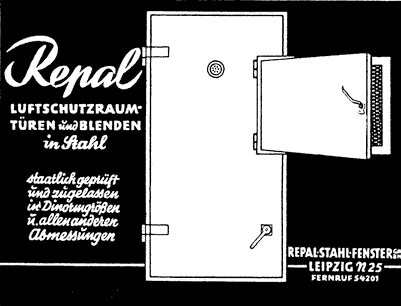
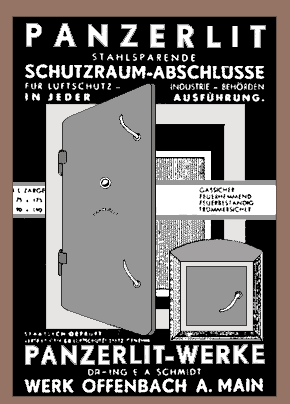
German advertisement for gasproof Türen
(doors)
and Blenden (shutters or windows).
Farther on, there is a discussion of the kinds of shelters one would
expect at a factory or large work place: such a bomb shelter complex
(Schutzraumbau) would comprise several parts, including an command
center (Befehlsstellen), an emergency room
(Rettungsstellung), and a decontamination center
(Entgiftungsanstalten) [LDB, 205]. The entire structure would be
equipped with gas detectors (Gaspürer) [LDB 208], and the people
entering would go through a gas tight steel door. This waiting room should
be rather large, to accommodate people comfortably during an air raid.
From the waiting room, doors lead on the one side to the
treatment rooms and on the other side to sleeping quarters. Among the
treatment rooms for the wounded and for those exposed to poison gas
there is a doctor's office and an operating room. In large layouts the
doctor's office and the operating room are separate. Farther on there
will be sleeping quarters, shelters for lightly wounded, and
decontamination centers.
Vom Warteraum
führen Türen einerseits in den Behandlungsräumen und andererseits in den
Liegeraum. Zwischen den Behandlungsräumen für Verwundete und für
Gasvergiftete liegt ein Artztzimmer und ein Raum zur
Operationsvorbereitung. Bei größeren Anlagen werden Behandlungsraum und
Operationsraum getrennt. Ferner treten weiter Liegeräume, Schutzräume
fur Leichtverwundete, und Entgiftungsanstalten zu der Anlage hinzu [LDB
210]
So far, we can see that the German bomb shelter is a relatively
sophisticated operation, including a systematic design and a division of
functions. In addition, the references to gas tight doors, buckets for
contaminated clothing, wash rooms, changing rooms, and decontamination
centers reflects a very real concern with the possibility of poison gas
attacks.
Our second document is entitled
Schutzraumabschlüsse [Bomb Shelter Seals], Berlin, 1939, by
Doctor-Engineer R. Scholle; hereinafter, [S].
This booklet
describes in great detail the ways in which a bomb shelter
(Schutzraum) should be made gas tight; indeed, Scholle emphasizes
that a shelter needs to be secure from poison gas (gassicher),
debris (trümmersicher), and bomb splinters (splittersicher)
[S 2]. Scholle specifies that the protection from debris and bomb
splinters should be on the outside, while the protection from gas
should be on the inside, of any window or emergency exit [S 3].
This would mean, in practical terms, that any screening or grille-work
would be on the outside, and any gas tight cover would be on the inside,
of an opening.
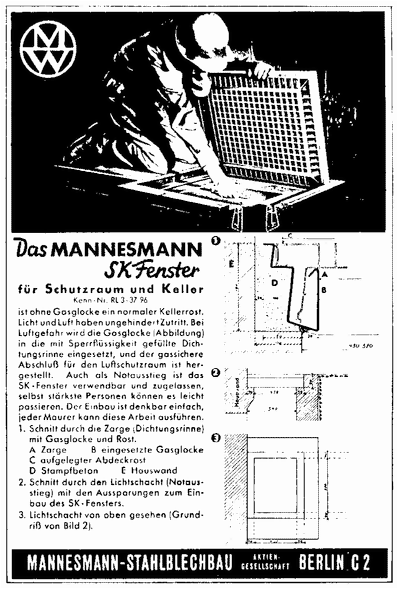
On the subject of windows and other openings, he specifies what their
dimensions should be, if they are to be used for emergency exits:
Windows or other wall openings may be of any size. But if these
openings are to be used as emergency exits, then they must under all
circumstances allow a passage of 50 by 50 centimeters.
Abmessungen für Fenster und sonstige Wandöffnungen
sind freigestellt. Sollen diese öffnungen jedoch als Notausstiege
verwendet werden, so müssen sie unter allen Umständen eine lichte
Durchgangsöffnung von 50x 50 cm frei lassen. [S, 5]
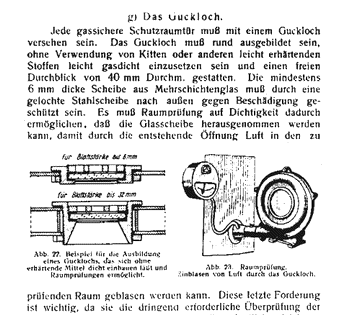
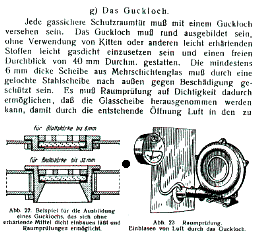
He also describes the need for bomb shelter doors to be gas tight and
to have a gas tight peephole:
Every anti-gas bomb shelter door must be equipped with a
peephole. The peephole should be made round, without the use of putty or
other easily hardened materials to be made gas tight, and it should have
a view of 40 millimeters. The disc of multi-layered glass of at least
six millimeters in thickness should be protected from damage with a
perforated steel plate.
Jede gassichere
Schutzraumtür muß mit einem Guckloch versehen sein. Das Guckloch muß
rund ausgebildet sein, ohne Verwendung von Kitten oder anderen leicht
erhärtenden Stoffen leicht gasdicht einzusetzen sein und einen freien
Durchblick von 40 mm Durchm. gestatten. Die mindestens 6 mm dick Scheibe
aus Mehrschichtenglas muß durch eine gelochte Stahlscheibe nach aussen
gegen Beschädigung geschütz sein. [S, 21]
The purpose of the peephole in a bomb shelter door was so the Fire
Warden could check on the inhabitants of a shelter, to ensure their needs
and safety. Thus the thin glass disc would be recessed in the door, and it
would be the inside, flush to the door's surface, that would require
protection against damage. [cf. photos, S 32, 37] Although a perforated
steel plate would be the preferred protection, it should be clear that a
number of other means could be used. [8]
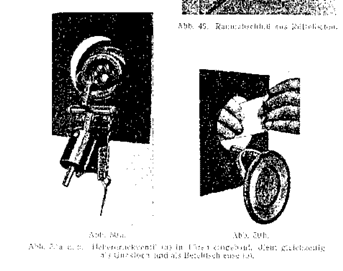
Further on, Scholle describes the need for a threshhold to place at the
base of the gas tight door. The caption to one photograph reads:
Upturned threshold, standing in the doorway. The threshold is
bolted to the floor, when gas tightness is required.
Hochgeklappte Schwelle, die in der Türöffnung stehenbleibt. Die
Schwelle wird auf dem Boden festgeschraubt, wenn Gassicherheit
erforderlich ist. [S, 22]
The photograph depicts a flat iron bar leaning in a
doorway.
Section (k) contains a discussion, with several
photographs, of how to construct gas tight double doors.
A complete gas tight seal with a double-winged bomb shelter seal
was considered impossible for a long time, and even today not all
manufacturers have succeeded.. It depends on making the tight edges of
the two leaves of the seal gas tight.
Einwandfreie Gassicherheit von zweiflügligen
Schutzraumabschlüssen wurde fur lange Zeit für unmöglich gehalten und
gelingt auch heute noch nicht allen Herstellen. Es kommt darauf an, die
Dichtlinien von zwei Abschlussblättern gasdicht zu vereinigen. [S,
24f]
The booklet also discusses making gas tight doors with
wood, lined with felt [S 27, 28], and the use of concrete in creating
seals [S 31], overhead openings requiring a two part grate or grille
[Rost, S 34], and several other features.
Of
particular interest in the discussion of pressure release valves
(Überdruckventile). One of these is a peephole that is sealed by
means of a weight. The peephole can be pushed forward, creating an
aperture for the passage of air or even messages (S, 37, 32). A more
typical Überdruckventil consists of a pipe that is fitted into the
bomb shelter wall. The open end of the pipe faces the outside, the inside
end is closed, but at the bottom of the inside end there is an opening
that is sealed with a rubberized screw-on cap (S 38).
Our third document is the periodical Gasschutz und Luftschutz
[Gas Defense And Civil Air Defense], for the year 1939, then in its 9th
year of publication; hereinafter, GL and publication year.
The article "Der Zivile Luftschutz auf den Frühjahrausstellungen
1939" by Heinz-Guenther Mahl describes the latest advances in civil
defense technology at a civil air defense exhibition in Leipzig. Attention
is given to all the usual features of bomb shelters, including mechanisms
for achieving darkening (Verdunklung). Darkening was considered
very important: it was the first thing to achieve in an above ground bomb
shelter in the event of an air raid (GL39, 5), and the regulations
stipulated that lights had to be dimmed so that no light was visible at
500 meters (GL39, 264). Indeed, a further article by Mueller, "Über das
Sehen im Hellen und Dunkeln" (GL39, 323ff) describes the use of
colored lights (farbiges licht) for darkening (GL39, 325).
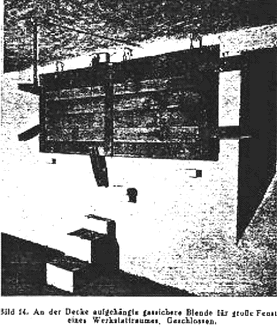
The Leipzig article also contains a discussion of modifications for
bomb shelters, including doors and window shutters, which can be made of
several materials, as well as a discussion of ways of making chimneys and
smoke stacks gas tight:
Bomb shelter doors and window shutters come in many different
varieties, they are made out of steel, steel saving constructions, wood,
and other building materials . [....] Among gas protective chimney seals
there is a novelty that does not use a steel frame [....] consisting of
a rubber flap that is pressed against the frame of the concrete chimney
flue by means of a bolt. This construction not only saves steel but also
solves the problem of the frame rusting. Another construction for a
chimney seal uses a rubber plate which normally hangs loose, but which
can be placed into position by means of a hook on the inside of the
external flue in order to achieve gas tightness in the chimney shutter.
Schutzraumtüren und Fensterblenden wurden in
zahlreichen und unterschiedlichen Ausführungen -- aus Stahl, in
stahlsparender Bauweise, aus Holz, und aus Baustoffplatten -- angeboten.
[....] Unter den gassicheren Schornsteinabschlüsse fiel als Neuheit eine
Konstruktion auf, die keine Stahlzarge mehr aufweist [....] der in einer
Nute des Verschlußdeckels liegende Gummi Hohlschnurriemen wird vielmehr
gegen die als Rahmen ausgebildete Betonzarge gepreßt. Diese Konstruction
spart somit Stahl unde vermeidet überdies ein Undichtwerden durch
Rostbildung an der Zarge. Eine andere Konstruction einer
Schornsteinreinigungstür benutz zum Abdichten eine Gummiplatte, die im
Frieden ausgehängt ist and lediglich bei Aufruf des Luftschutzes mittels
einiger Aufhängehaken an der Innenseite der äußeren Verschlußklappe
befestigt zu werden braucht, um die Gasdichtheit der Schornsteinklappe
herzustellen [GL39, 111]
Also in 1939, Dr. Engineer Karl Quasebart contributed an article on
"Werkrettungsstellen" [Work Place Emergency Rooms], which contains
a floorplan for a typical anti-gas shelter:
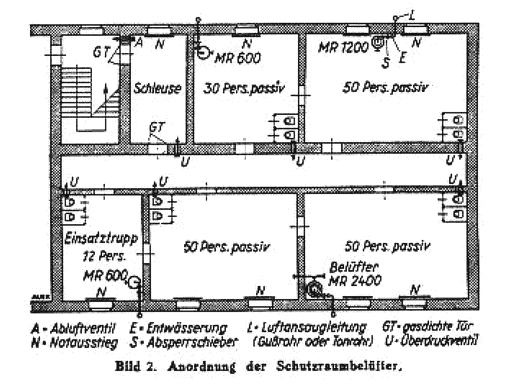
A-Exhaust E-Drainage L-Air intake GT- Gas tight door N- Emergency
exit S- Stop valve U- Pressure release valve
A-Abluftventil E-Entwässerung L-Luftansaugleitung GT-Gasdichte
Tür N-Notausstieg S-Absperrschieber U-Überdruckventil [GL39, 236]
The same article contains recommendations (GL39, 237) on the
establishment of an emergency room (Werkrettungsstelle),
particularly for gas attacks, as part of the bomb shelter complex:
Those who have been exposed to Yellow Cross or are suspected of
same [however] are divided by sex in the undressing rooms, and go from
there to the shower rooms, and to the dressing rooms, where extra
clothes are available, and from here back to the waiting room, for
further transport or direction to the doctor's office.
Die Gelbkreuzverletzten oder -verdächtigen dagegen
gelangen, getrennt nach Frauen und Männern in die Auskleideräume,
Duschräume, Ankleideräume, in denen saubere Notkleidung zur Verfugen
steht, und von hier wieder in den Warteraum entweder zum Abtransport
oder zur Weiterleitung in den Artztraum.
"Yellow Cross", according to the Wehrmacht system for classifying
gases, denotes vesicants, or blister gases [US 528, see below]. Thus
undressing rooms and showers were part of the decontamination process, and
were envisioned as an integral part of the bomb shelter complex, as indeed
we have already seen [LDB 210].
Dr. Quasebart's article also
contains photographs of these decontamination facilities. A
Duschraum [Shower room] could contain showers, but the photograph
labeled Duschraum shows not showers but three water taps with hoses
attached and coiled around exposed upright pipes [GL39, 237]. Another
photo, captioned "Bade- und Duschraum für Kampstoffverletzte" [Bath
and shower for gassing victims] shows a bathtub with a more typical shower
arrangement attached [GL39, 239]. Clearly, the concepts of
Duschraum and decontamination center were rather elastic in their
application.
Another article, "Aus der Praxis für die
Praxis im Werkluftschutz" [Practical Lessons for Work Place Bomb
Shelters] by Major a. D. Stein contains a discussion of fulfilling bomb
shelter requirements. On the subject of protecting apertures, in place of
the more expensive steel, he recommends "Baustahlgewebe" which he
describes as "wire mesh of varying gauges that has been welded together at
certain points" and which is a good substitute, especially for
constructing covers:
ein Geflecht von Draht verschiedenen Abmessung mit
verschweißten Schnittpunkten bietet einen sehr guter Ersatz, inbesondere
auch für Decken konstruktion. [GL39, 263].
Our fourth document is the periodical Gasschutz und
Luftschutz , for the year 1940. In March of that year its name was
changed to Baulicher Luftschutz [Civil Air Defense Construction];
hereinafter, BL and publication year.
A particularly
noteworthy article entitled Behelfsmässige Luftschutzräume, falsch und
richtig [Do it Yourself Bomb Shelters, Right and Wrong], by Doctor
Engineer Ernst Baum, appeared in that year [GL 22ff]
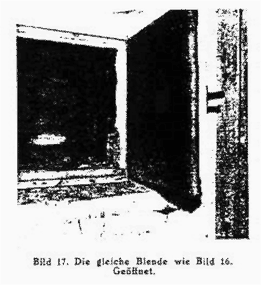
The article contains several photographs [passim] of
gassichere Fensterblende [gas tight window shutters], most of which
are constructed of wood. It also describes an incorrect method for fixing
a shutter up against the grating of the window grille:
Making a window gas tight, according to the regulations, is one
of the easiest measures. But even so one observes many mistakes relating
to gas tight shutters. It is wrong, for example, to wrap a board in
cloth and press it up against the grating of the window grille with a
Christmas tree pole. [GL40, 26]
Fenster
gassicher abzuschließen, sollte an Hand der erlassenen Vorschriften zu
den einfachsten Maßnahmen gehören. Und trotzdem konnten bezüglich
gassicherer Blenden zahlreiche Fehler beobachtet werden. Falsch ist es,
z. B., ein Holzbrett mit einem einfachen Tuch zu bespannen und mit Hilfe
eines Weihnachtsbaumstammes von unten gegen die Gitterstäbe des
Fensterschachtrostes zu pressen. [GL40, 26]
The article includes a specific reference to Holzblende
[shutters made of wood] (GL40, 26).
Another article of interest, entitled Bemerkungen zur Verorderung
und den Bestimmungen über die behelfsmässige Herrichtung von
Luftschuträumen , by K. Otto, Referent im Reichsluftfahrtministerium,
offers a series of recommendations for do-it-yourself bomb shelters,
including the following suggestion, that bomb shelters should be used for
other purposes when not actually used for air raids:
According to Regulation #12, bomb shelters should only be used to
the extent that the necessary three cubic meters of breathing room per
person is maintained, and secure passage to the space is ensured. In
this case, only things should be left in the bomb shelter that do not
compromise or endanger its use as a bomb shelter. If conditions do not
make it otherwise possible, then it is permissable to leave furniture,
boxes, and other things like potatoes, coal, and other supplies in the
bomb shelter.
Luftschutzräume brauchen nach Nr. 12 der
Bestimmungen gegebenfalls nur soweit ausgeräumt zu werden, bis der
notwendige Luftraum von 3 m^3 je Person und sichere Begehbarkeit
gewährleistet sind. In diesem Fall dürfen nur solche Dinge im
Luftschutzraum belassen werden, die seine Nutzung als Luftschutzraum
nicht beeinträchtigen oder gefährden. Wenn eine anderweitige
Unterbringung nicht möglich sein sollte, so ist es jedoch zulässig,
Möbel, Kisten, und andere Gegenstände sowie Kartoffeln, Kohlen, und
andere Vorräte im Luftschutzraum zu belassen. [GL40,
8)
It should be noted that these specifications pertain to improvised
shelters, i.e., shelters which would not be expected to have a
sophisticated ventilation system. As we shall see, the maximum limits of
occupancy for ventilated shelters were different.
Our fifth
document is Baulicher Luftschutz , for 1942 ; hereinafter, BL and
publication year.
It contains a lengthy article entitled
Hygienische und physiologische Grundlagen für den Bau von
Luftschutz-Bunkern , by Dr. W. Liese, Reichsgesundheitsamt. [BL42,
104-110]. It makes several remarks on recommended temperatures for bomb
shelters, air circulation, and other relevant topics.
Of
particular interest is a discussion of Pettenkofer's Rule on the
accumulation of carbon dioxide in a closed space, which holds that the air
is not breathable once CO2 levels exceed a constant of 1.5:
We know today that the basic parallel between CO2 content and the
development of obnoxious odors is only general, and can be influenced by
a number of other factors. Nevertheless, Pettenkofer's Rule can still be
used for practical purposes. Let us take as an example the sleeping
quarters of a bomb shelter, where 2 cubic meters of air space are
available to each person. We can see that the CO2 levels will exceed
hygienic levels at 2 or 3 percent after 3 hours, and that fresh air must
be made available. By reference to this maximum load we derive a
relation, with whose help we can roughly calculate when a closed space
will need fresh air. That is, the volume of the space is divided by the
number of occupants and the quotient is multiplied by 1.5. For example:
Room volume: 60 cubic meters, Persons 60, therefore 1.5 x 60 : 60 = 1 x
1.5 = 1.5, i. e. the limit is reached in this case after 11/2 hours. If
one wanted the air space in a bomb shelter to achieve very high levels
of adherence to Pettenkofer's Rule, such that the CO2 levels did not
exceed 1 per thousand, then it would be necessary to supply each
occupant with 30 cubic meters of fresh air, or in other words an
availability of about 15 air exchanges.
In Nr. 6 (1) of
the Regulations on the Ventilation, Heating, and Cooling of Bomb
Shelters it is prescribed that each person should receive 18 cubic
meters of fresh air per hour.
Wir wissen
heute, daß die zu Grunde liegende Parallele zwischen Kohlensäuregehalt
und Anreicherung an Riech- und Ekelstoffen nur bedingt richtig ist und
durch andere Einflüsse stark verschoben sein kann. Immerhin kann die
Pettenkofersche Angabe als Richtlinie nach wie vor mit praktischem
Nutzen gebraucht werden. Wir, wollen uns vor Augen führen, daß im
Schlafraum der LS-Bunker je Kopf knapp 2 m^3 Luftraum zur Verfügung
stehen. Wird lediglich dieser Luftraum betrachtet, so heißt das, daß
nach rund 3 Stunden die Kohlensäure die hygienish zulässige Grenze von
höchstens 2 bis 3 v.H. zu erreichen beginnt und Frischluft zur Verfügung
stehen muß. Unter Benutzung dieser Belastungsgrenze gibt es eine
Beziehung, mit deren Hilfe ungefähr überschlagen werden kann, wann im
geschossenen Raum Lufterneuerung notwendig wird. Danach ist der
Rauminhalt durch die Zahl der Personen zu teilen und dieser Wert mit 1.5
zu multiplizieren. Beispiel: Rauminhalt 60 m^3, Personenzahl 60, also
1.5 x 60 : 60 = 1 x 1.5 = 1.5, d. h. 11/2 Stunden wäre in diesem Falle
die Grenze erreicht. Wollte man für den Luftraum des LS-Bunkers von rund
2 m^3 den hygienisch sehr hohen Anspruch der Petterkoferschen Regel
gelten lassen, d. h. sollte der Kohlensäuregehalt der Raumluft nicht
mehr als 1 v.T. betragen, so müßten je Stunden rund 30 m^3 Frischluft je
Person zugeführt werden oder mit anderen Worten ein annähernd 15 facher
Luftwechsel gewahrleistet sein.
In Nr. 6 (1) der
Bestimmungen über die Belüftung, Heizung und Kühlung der LS-Bunker wird
je Person eine Frischluftmenge von 18 m^3 Stunde vorgeschrieben. [BL42,
105]
The above makes it very clear that the preferred air space in any
given bomb shelter equipped with a ventilation system would be 2 cubic
meters per person, with 30 cubic meters of fresh air per person per hour,
for an hourly venting capacity (Y/2 = 1/2Y x 30 = 15Y) of fifteen
air exchanges per hour, and that the regulations stipulate a minimum of 18
cubic meters of fresh air per person, which would mean, at a maximum
volume of 1 person per cubic meter, eighteen air exchanges per
hour. We would therefore expect bomb shelters with ventilation systems to
demonstrate comparable capacities.
Another interesting
aspect of the article involves temperatures: referencing Regulation #7 for
LS-Bunkers, it recommends air temperatures of 17 C, and surface
temperatures of 16 C. [BL42, 107] Hence, an attempt to heat or warm bomb
shelters by the use of stoves or heated air would be simply an attempt to
accord with these regulations.
A further article, Einfluß
der Heizung und Belüftung auf die Planung von LS Bunkern , by Doctor
Engineer Hermann Schrader, Regierungsbaurt im RLM, [BL42, 110-116] covers
the air circulation systems in much greater detail with several drawings.
The periodical contains several advertisements for this
year, including:

Drahtegeflechte / Drahtwarenfabrik / Otto Christ / Mannheim
Käfertal , [BL42, v of advertisements]
Gasschutztüren und Blenden / geprüft RL 3 - 37/234 / Unbedingte
Betriebssicherheit! / Die einfache Bauart ermöglicht leichte, schnelle
Bedienung / Albus Stahltüenwerk / Dortmund [BL 42, v1 of
advertisements]
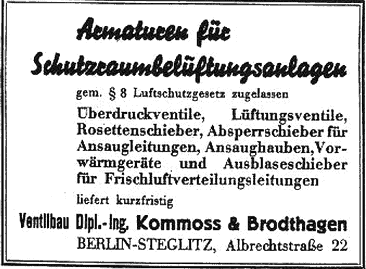
Armaturen für Schutzraumbelüftungsanlagen / gem. 8
Luftschutzgesetz zugelassen / Überdruckventile, Lüftungsventile,
Rosettenschieber, Absperrschieber für Ansaugleitungen, Ansaughauben,
Vorwärmgeräte und Ausblaseschieber für
Frischlüftverteilungsleitungen [BL 42, V of
advertisements]
Our final source is an issue of the US War Department, "Handbook on
German Military Forces," originally published in March of 1945. It was
reissued in 1990 by Lousiana State University Press with a forward by
Stephen E. Ambrose, hereinafter, US.
Chapter VIII, section
VI is devoted to German Chemical Warfare Equipment. Several aspects are
discussed, including, for example, decontamination vehicles (Kfz 93) for
clothing, utilizing steam [US 522f], decontamination trucks (Kfz 92) for
personnel, which could shower 150 men in an hour [US 522f], and a variety
of other gas protection devices for personnel, horses, and even dogs and
pigeons.
The text specifically mentions anti-gas shelters
[US 518], while subsection c. discusses no less than 15 German gas
detectors, including gas detector sets for fortifications, and gas
detection laboratories [US 526]. The section also specifically references
a German awareness of the potentialities of cyanide compounds for war
purposes, from which we infer that the gas detectors included those that
could detect the presence of cyanides in the atmosphere.
The
section also contains a photograph of several Schutzraumbelüfter,
called "collective protectors" in the manual [US 527]. The photo shows the
extensive overhead ductwork suspended from the ceiling by stirrups
(Bügel): since the ceiling appears to be of concrete formwork, we
would suspect that the stirrups are attached to some other element in the
concrete, possibly flat wooden squares. It is worth noting also that
Bügel are frequently used on the outside of above ground bomb
shelters to brace fortifying elements -- timber, sandbags, concrete, etc.
[cf. BL42, 202].
This concludes our brief review of German
bomb shelter, or anti-gas shelter, literature from WWII, including an
easily accessible document from an American source.
On the
basis of the above extracts, the following conclusions may be safely
drawn:
1) From no later than 1939, German bomb shelters were also
constructed to be anti-gas shelters.
2) German bomb
shelters, or anti-gas shelters, had a sequential organization allowing
for decontamination and several other functions. In large structures,
these functions would have separate rooms.
3)
Decontamination procedures featured a sequence of undressing, showering
or washing, and medical attention. In large structures, each function
would have a separate room.
4) Bomb shelters, although
usually underground, could be above ground.
5) Particular
attention had to be paid to darkening in the event of an air
raid.
6) German bomb shelters or anti-gas shelters
featured an elaborate system of ventilation, which drew air from ceiling
height and filtered it out near the bottom. The ventilation ductwork
would be suspended from the ceiling. In addition, the regulations
recommended ventilation capacities allowing for anywhere from 15 to 18
air exchanges. Regulations recommended that the air in bomb shelters be
heated to 17 C.
7) A standard feature of a German shelter
was a gas tight door. These could be made of either wood or steel, and
have one or two doors. The seal could be achieved with either rubber or
felt.

At left: The door at the concentration camp Majdanek from
which the USHMM made the replica which is now on display in Washington
D.C.. At right, the real function of the door and thousands more like it
is shown in a widely distributed German ad for bomb-shelter doors and
window covers, military and civilian.
8) Gas tight doors had peepholes, whose glass had to
be protected from damage: this was usually achieved with a perforated
steel plate, but obviously other means could be used.
9) A
flat iron bar was frequently bolted along the base of a gas tight door
to create a gas tight seal.
10) Windows were usually
covered with grating, mesh, or grille of some kind to protect against
splinters and rubble.
11) Emergency exits were also
covered with a grating, mesh, or grille of some kind to protect against
splinters and rubble.
12) Both windows and emergency exits
would be covered with gas tight shutters, inside the grating, mesh, or
grille. The shutters could be made of steel or wood.
13)
An ad for wire mesh [Drahtnetz], appears in one periodical, from
which we infer that it was a common material used for window or
emergency exit gratings, mesh, or grilles. There is also a specific
reference to using wire mesh screens for splinter and debris
protection.
14) Chimneys and smoke stacks were also
designed to be gas tight.
15) Gas detectors were a common
feature of German military equipment. That the German Army was equipped
to detect HCN is a safe inference.
16) The literature for
civil defense was large, boasting a large number of synonyms and
neologisms as is typical of a new concept which takes time to
standardize its vocabulary. For example, poison gas victims are
described as "Gelbkreuzverletzte", "Gasvergiftete", and
"Kampstoffvergiftete": hence, when reviewing material evidence of
bomb shelters we should expect similar variability in the use of words.
Part II: The Criminal Traces of J. C. Pressac
Before discussing the criminal traces, a few preliminary
observations seem appropriate.
The criminal traces
represents an attempt to prove, strictly on a material basis, the
existence of extermination gas chambers in the crematoria at Birkenau. It
deliberately avoids as much as possible recourse to witness testimony, or
postwar affidavits.
But by the time most students of the
Holocaust get to the criminal traces their minds are already fairly well
made up. Conventionalists tend to be logocentric, that is, they focus on
the words of witness testimony and postwar affidavits as proof of the
extermination gas chambers. Any and all material evidence is simply
supplemental. Revisionists, on the other hand, tend to be object-oriented,
that is, they look at the totality of the physical and structural evidence
at the Birkenau complex to conclude that no gas exterminations took place.
Therefore, when confronted with a possible criminal trace, revisionists
tend to offer explanations that are sometimes neither well thought out nor
corroborated by other evidence.
It follows that, if this
proposed explanation for the criminal traces is correct, conventionalists
will ignore the interpretation, even if they may be forced to grant the
non-existence of any criminal traces whatsoever. Revisionists, on the
other hand, will consider this explanation as simple additional proof that
no gas exterminations took place in the morgues of the Birkenau
crematoria.
Criminal Trace #1: The
"Vergasungskeller" note.
This is the oldest of
the criminal traces, a letter from an SS captain to Berlin, which uses the
word "Vergasungskeller." Originally generated during the Nuremberg
trials, it was taken by Gerald Reitlinger (1954) as proof of a gas
chamber. Beginning in 1976, revisionists offered other explanations.
Arthur R. Butz argued that it might have referred to a room for
carbureting the gases for the crematorium. Robert Faurisson has argued
that it referred to a storage room for Zyklon B. Last year, Arthur R. Butz
proposed that it referred to an anti-gas shelter. [9]
All
these interpretations are plausible insofar as the word
Vergasungskeller is a neologism. The real question is whether it is
a neologism to refer to a new function, the conventionalist view, or
whether it is a neologism to refer to a known function, the revisionist
view. Neither proposition can be definitely proved, but as we shall see
several of the documents that Pressac cites contain unconventional
wordings.
This should be stressed:
Vergasungs[keller] occurs in no other known documentation or
literature from this era. Moreover, the primary meaning of the verb
vergasen is to gasify, that is, the verb primarily refers to the
process of turning something into a gas. In 1943, only a secondary meaning
referred to attacking with a gas, and that in a military context.
Vergasung terminates in a -ung, and such
words from German are frequently translated into English with -ing
and are seen as gerunds, that is, expressing an incomplete or ongoing
verbal action: thus we have Wohnung (dwelling, where one dwells),
Kleidung (clothing, or how one is clad), and therefore
Vergasung, meaning "gassing." On the other hand, -ung is
also frequently used in German to express simple verbal nouns, for
example, Entscheidung (decision, having decided), Erfindung
(invention, having invented), and therefore Vergasung, meaning
"gasification." This last class of nouns reminds us that there are many
German words in which -ung does not refer to an ongoing or even
future process, but to a completed process of the verb: thus, for example,
Stimmung (pitch, the perfective of tuning), Tötung
(homicide, the perfective of killing), Verletzung (wound, the
perfective of wounding). This is important when we turn to words to
describe gassing victims.
Gaserkrankung does not mean
becoming sick from gas or going to become sick from gas: it refers to
having become sick from gas. Similarly, Vergiftungen refers to
people who have been poisoned, not those who are being, or will be,
poisoned. Such terms are common in the literature. Therefore, we can say
that Vergasung refers not to gasification nor to gassing but rather
to the condition or state of having been gassed. In this case,
Vergasungskeller would mean a cellar meant for those (note the
genitive -s) who have been wounded with poison gas.
In short, etymological arguments turn on whether
Vergasungskeller refers to a space where people are gassed, a space
where people take shelter from gas, or a place where people are treated
after having been gassed. The last two arguments are closely linked, but
none of these arguments stands alone outside of a larger
context.
It is clear that in itself this designation is not
a criminal trace, since perfectly benign interpretations are possible. Its
criminality is only defined by the weight of any corroborating material
evidence. We will return to this term at the end of our review of the
other criminal traces.
Criminal Trace #2: 10 Gasprüfer
(gas detectors)
As noted above, Gasprüfer and
Gasspürer were common in German chemical warfare equipment and in
anti-gas shelter equipment. [Source: US 525ff] A benign interpretation is
possible, therefore it is not a criminal trace.
There is
more to this trace. In 1993, Pressac published another book, which was at
once a condensation and augmentation of the first, Die Krematorien von
Auschwitz [Munich:1994, hereinafter, DKA]. In it he quoted a letter
from Kurt Prüfer to the Auschwitz Bauleitung, in which he claimed
that he had unsuccessfully sought to acquire the 10 gas detectors, which
he now specified as Anzeigegeräte für Blausäure-Reste ["Indicators
for HCN residue", DKA 93], and there is indeed no record that they
were ever located or delivered. At any rate, they were not available for
the purpose which Pressac assumed. [DKA 94] If we chose, we could dismiss
this criminal trace right now: the Germans had been gassed with HCN in
World War One, expected its use, and had prepared for it. The presence of
HCN detectors has no criminal significance at all.
But
there is still a problem: why would one ask an oven maker to purchase gas
detectors? In other words, we know that the manufacturers of Zyklon had
HCN gas detectors, and we are certain that the Wehrmacht and the SS had
their own. Thus, why would one ask the builders of the cremation ovens for
gas detectors, and why ten in number? The simplest answer is that these
gas detectors were meant for the 10 three-muffle cremation ovens that
comprised Crematoria II and III, and they probably were meant to have some
characteristic (heat resistance) to make them usable in or by the ovens.
That the gas detectors would be meant for Crematoria II and III makes
sense, because, first, Pressac notes that the crematoria were always
discussed as pairs (II and III, IV and V) [ATO, 452], and because
Crematoria IV and V did not have 10, but rather 4 double muffle ovens
apiece.
Then we have to ask what their function would be.
Pressac argues that these detectors prove gassings with Zyklon B in the
crematoria: but in the event of such gassings, certainly the crematoria
operators would not need to be informed that dangerous concentrations of
the gas were nearby. In other words, the need for detectors for the ovens
suggests the ability to detect the presence of HCN residues created by
other processes, but not by the release of pure HCN in the Crematoria.
In early March, 1997, Dr. Arthur R. Butz argued that the
incineration chute behind the cremation ovens of Crematoria II and III
could have generated high levels of HCN in the crematory ductwork if
certain fabrics were burned. There is merit to this argument, since it is
known that German uniforms from the beginning of the war were composed of
a wool-rayon combination, and that the proportion of rayon increased
throughout the war [US 541ff]. It is not unreasonable to assume that most
concentration camp fabrics contained similar proportions of wool and
rayon, nor is it unreasonable that highly flammable rayon fabrics would be
treated with flame retardant which would provide a catalyst for HCN
release when burned.
In addition, our review of the
literature has shown that several other substances produced HCN, and could
have a poisonous effect, including leather, celluloid, and proteinous
matter. All of these could have been burned in the incinerator as well. [G
55]
The counter argument is that these gas detectors had
special characteristics that were meant for measurement for homicidal
gassings. Aside from this being purely speculative, the argument offers no
clue as to what these characteristics might be, nor does the counter
argument explain why so many would be needed or how they would be used or
consulted in a space that after all had only one door. Nor does the
counter argument explain why, if the 10 gas detectors sought were
important for homicidal gassings, why such gassings were supposed to have
proceeded, presumably using nothing more than the typical DEGESCH gas
detectors.
Recognizing that the problem is not a question of
the criminality of these detectors, but rather a question of why
Topf should be acquiring them, I accept the general validity of Dr.
Butz' thesis and direct the interested reader there. [10]
Criminal Trace #3: 1 Stck Handgriff für Gastür (handle for a gas
tight door)
Gas tight doors were a common feature to
anti-gas shelters. [Source: S 21, S24f, BL42, v1, BL40, 236] We note that
the notation contains an abbreviation: Stck for Stück: there
will be other examples of apparent abbreviations. A benign interpretation
is possible, therefore it is not a criminal trace.
Criminal Trace #4: Auskleideraum (undressing room)
This is only a relative criminal trace, that is, it is criminal
only insofar as some other criminal trace(s) can be proved. Undressing
rooms were a common feature to bomb shelters, forming part of the
decontamination sequence [LDB 180, 205, 210; GL39, 237]. A benign
interpretation is possible, therefore it is not a criminal
trace.
Criminal Trace #5 Auskleidekeller, Auskleidekeller
II
This is only a relative criminal trace, that is, it
is criminal only insofar as some other criminal trace(s) can be proved.
Undressing rooms were a common feature to bomb shelters, forming part of
the decontamination sequence [LDB 180, 205, 210; GL39, 237]. A benign
interpretation is possible, therefore it is not a criminal
trace.
Criminal Trace #6 Gastür 100/192 (Gas tight door,
100 x 192)
Gas tight doors were a common feature to
anti-gas shelters. [Source: S 21, S24f, BL42, v1, BL40, 236] A benign
interpretation is possible, therefore it is not a criminal trace. The
complete order adds: "Gastür ... mit Guckloch aus doppeltem 8 mm Glas
mit Gummidichtung und Beschlag ..." which Pressac interprets as a
peephole, rubber sealing strip for the door (which Pressac claims was
replaced with felt [ATO 434]), and a frame. But in fact these
specifications match a typical bomb shelter door [S 21], with
multi-layered glass peephole of at least 6 mm thick, gas tightness, and
with a clasp or cover (Beschlag.) This should be considered a
clear-cut reference to an anti-gas shelter door.
Criminal
Trace #7 Gasdichtetür (Gas tight door)
Gas tight doors
were a common feature to anti-gas shelters. [Source: S 21, S24f, BL42, v1,
BL40, 236] A benign interpretation is possible, therefore it is not a
criminal trace.
Criminal Trace #8 4
Dratnetzeinschiebvorrichtung
and
Criminal Trace #9 4 Holzblenden
Since these two
elements on the inventory agree in number, and were written in, it is
assumed by all parties that their function is connected.
Blenden are simply shutters, and may be made from either steel
or wood. They were commonly used in anti-gas shelters in order to make an
opening gas tight, such as a window, or any other opening [Source: GL39,
111; GL40, 22ff; GL40, 26]. A benign interpretation is possible, therefore
it is not a criminal trace.
Further on this point, Pressac
[ATO, 425ff] provides several photographs of shutters, which are
identified as the gassdichten Fenster (or Türen) of
Crematoria IV and V. These shutters are generally identical in size,
shape, and construction to ordinary wooden Blenden as can readily
be seen by consulting the literature cited above, and they are also of the
right size for emergency exits. Thus gassdichten Fenster (or
Türen ), Blenden and Holzblenden, and wooden shutters are all
the same thing. This is important not only because it demonstrates the
propensity of the Birkenau construction workers and engineers to describe
things by unconventional names, but also because it helps put
Drahtnetzeinschiebvorrichtung in context.
Drahtnetzeinschiebvorrichtung is a neologism, and we cannot
offer a definitive explanation. Pressac speculates that it represents a
wire mesh device whereby Zyklon B was "induced" into the extermination gas
chamber, but there is no material corroboration for this. We offer the
following observations to support our inference:
1) At
least two advertisements depict wire mesh screens in the anti-gas shelter
literature, one depicts a screen behind an open shutter. [Source: BL42,
v]
2) The anti-gas shelter literature contains an
advertisement for wire mesh [Drahtnetz]. [Source: BL42,
v]
3) According to the anti-gas shelter literature, all
windows and other openings require some kind of mesh, netting, grating or
grille [Rost, Gitterstäbe, Geflecht von Draht]. [Source: LB
182, 183; GL40 26; BL40, 263]
4) The Auschwitz work order
Nr. 353 dated April 27, 1943 [ATO, 441] contains an order for "12
stücke Fenstergitter 50 x 70 cm" which is accepted as a reference to
wire mesh screens or grilles for the 12 gassdichten Fenster (or
Türen), noted above as identical to Blenden and
Holzblenden.
5) Therefore, we can propose that the
Drahtnetzeinschiebvorrichtung bear a relationship to the
Holzblenden similar to the relationship of the Fenstergitter
to the gassdichten Fenster (or Türen ) of Crematoria IV
and V.
6) In addition, the literature specifies that such
openings must be available for emergency egress. Hence, we hypothesize
that these inserts must be removable. [Source: S 5, LDB 174ff, 182, 183]
7) There are several references in the anti-gas shelter
literature to "Schieber" which serve the function of something that
slides in and blocks, filters, or mediates a space (Absperrschieber,
Rosettenschieber, Aufbläseschieber). All of these characterize a
"Schieber" as something that is slid into something else, none of
them describe a device that is slid into something else so that something
else can be slid into it. [Source: advertisement, BL42, V] Therefore, we
conclude that the characterization of Drahtnetzeinschiebvorrichtung
as a "wire mesh induction device" is semantically incorrect.
8) Finally, the Auschwitz work order Nr. 78 dated March 11, 1943 [ATO,
440] contains an order in Polish "na wykonanie zaslon i kontowek dla
krematorium II /BW 30/ z tresci ktorego wynika, ze dla wykonania tego
samowienia zuzyto gaze druciana i druciana plecionke." which can be
translated as "for the manufacture of screens with scantlings [or screens
with edges] for Crematorium II /BW 30/ the gist of which is [z tresci
ktorego wynika] that wire gauze and wire mesh are to be used to meet
the order."
The above order is in Polish because the
original order is not available. According to Pressac, (ATO 438), someone
at the Auschwitz Museum borrowed the document for home study and didn't
return it. This is the only document missing, hence Pressac had to rely on
a Polish language abstract prepared for the Höß trial and notarized by Jan
Sehn. However, it seems clear that the order is significant in defining
the nature of the Drahtnetzeinschiebvorrichtung. The reference to
screens is not a reference to induction devices, and indeed, they sound
like the screens for emergency exits discussed earlier [LBD 174-177]. If
our rendering of the admittedly vague Polish is incorrect, it would be
helpful if the document was returned to the Museum where it
belongs.
Our hypothesis, then, is that the
Drahtnetzeinschiebvorrichtung were simply removable wire mesh
screens that were placed into openings that the Holzblenden were
designed to cover. The corroboration for this inference derives from the
points from the literature noted above. A benign interpretation is
possible, therefore it is not a criminal trace.
Finally, it
should be noted that Pressac himself has observed that the roof of Morgue
#1 of Crematorium II (for which these 4 pairs were designated) shows only
two holes in its largely collapsed but still intact roof (ATO, 436).
Therefore, in whatever manner these 4 pairs of
Drahtnetzeinschiebvorrichtung and Holzblenden were meant to
be used, they could not all have been used exclusively in the roof of
Morgue #1 of Crematorium II. This fact weakens Pressac's interpretation
concerning their construction and intent.
Criminal Trace
#10: Auskleideraum (undressing room)
This is only a
relative criminal trace, that is, it is criminal only insofar as some
other criminal trace(s) can be proved. Undressing rooms were a common
feature to bomb shelters, forming part of the decontamination sequence
[LDB 180, 205, 210; GL39, 237]. A benign interpretation is possible,
therefore it is not a criminal trace.
Criminal Trace #11
Gastür (Gas tight door)
Gas tight doors were a common
feature to anti-gas shelters. [Source: S 21, S24f, BL42, v1, BL40, 236] A
benign interpretation is possible, therefore it is not a criminal
trace.
Criminal Trace #12 Auskleidekeller (undressing
cellar)
This is only a relative criminal trace, that is,
it is criminal only insofar as some other criminal trace(s) can be proved.
Undressing rooms were a common feature to bomb shelters, forming part of
the decontamination sequence [LDB 180, 205, 210; GL39, 237]. A benign
interpretation is possible, therefore it is not a criminal
trace.
Criminal Trace #13 Flacheisen für
(1)/5Gastürbeschläge (Flat iron bar for 5 Gas tight doors)
Flat iron bars and other instruments were frequently used to improve
the seal on gas tight doors or gas tight shutters. For gas tight doors,
such bars would be placed along the side or the base of the door. [Source:
S, 22] A benign interpretation is possible, therefore it is not a criminal
trace.
Criminal Trace #14 Beschläge für 1 Stück Gastür
(fittings for 1 gas tight door)
Gas tight doors were a
common feature to anti-gas shelters. [Source: S 21, S24f, BL42, v1, BL40,
236] A benign interpretation is possible, therefore it is not a criminal
trace.
Criminal Trace #15 1 Gasdichtetür (1 gas tight
door)
Gas tight doors were a common feature to anti-gas
shelters. [Source: S 21, S24f, BL42, v1, BL40, 236] A benign
interpretation is possible, therefore it is not a criminal
trace.
Criminal Trace #16 14 Brausen (14 [DUMMY]
Showerheads)
There is no material reason for Pressac to
designate these showerheads fake. This is only a relative criminal trace,
that is, it is criminal only insofar as some other criminal trace(s) can
be proved. Showers were a common feature to bomb shelters, forming part of
the decontamination sequence [LDB 180, 205, 210; GL39, 237]. A benign
interpretation is possible, therefore it is not a criminal
trace.
In addition, it should be pointed out that this
reference to 14 showerheads pertains to Morgue #1 of Crematorium III,
not Crematorium II. (For Crematorium II we have the materially
unsubstantiated claim that it had 24 showerheads.) According to the
Crematorium II inventory, Morgue #1 was equipped with either 3 or 5 water
taps, which would be consistent with the equipment of a decontamination
shower room [GL39, 237].
Criminal Trace #17 12 Stück
gasdichten Tür ca. 30/40 cm (12 pcs. Gas tight doors)
These are a reference to the gas tight windows in Crematoria IV
and V. Gas tight windows were a common feature to German anti-gas shelters
[Source: GL39, 111; GL40, 22ff; GL40, 26]. The reader will note the
unconventional usage of the word Tür : This supports the
interpretation that the engineers and construction workers involved in
this project used unorthodox words to describe familiar, but differently
named, objects. In addition, as already noted, these objects are identical
to the Blenden discussed above. A benign interpretation is
possible, therefore it is not a criminal trace.
Criminal
Trace #17a, 17b 12 Stück gasdichte Tür (12 pcs. Gas tight doors,
fittings)
It is agreed that these are simply further
references to the gas tight windows described above. In addition, as
already noted, these objects are identical to Blenden. A benign
interpretation is possible, therefore these are not criminal
traces.
Criminal Trace #18 Gassdichtenfenster versetzen
(fit gas tight windows)
Pressac assumes this is a
misspelling. On the other hand, I am inclined to think that it was an
abbreviation for Gass[chutzraum]dichtenfenster i.e., "tight windows
for the anti-gas shelter." In any case, gas tight windows were a common
feature to German anti-gas shelters [Source: GL39, 111; GL40, 22ff; GL40,
26]. In addition, as already noted, these objects are identical to the
Blenden. A benign interpretation is possible, therefore it is not a
criminal trace.
More should be said on this subject.
Criminal Traces #18 and #19 derive from time sheets written out by the
foreman of a civilian construction firm which worked on the crematoria.
These contain two similar spellings, which Pressac considers misspellings:
gassdichtenfenster, and Gasskammer. Criminal Traces #20 and
#21 repeat the misspellings in a log book. I consider these misspellings
odd, because there is more than one mistake being made here.
In the first place, that a simple word like Gas would be
repeatedly misspelled and then copied seems very unlikely. Moreover, the
spelling used is ss, whereas if the writer truly thought that the
word was spelled ss a scharfes S or ß would have been
used. This is relevant, because the positioning of the double s in
both cases meets all the rules for ß usage: (a) it comes at the end
of a syllable in a compound word, (b) it comes before a consonant, and (c)
it comes after a long vowel. Therefore, to maintain Pressac's thesis of
misspellings we have to assume that both of the individuals involved not
only could not spell German, but could not write it either.
But in fact they could: for on the same line or just below the
offending spellings, we find the foreman and his copyist writing
Fußboden in accordance with the rules. Therefore the spellings of
gassdichten- and Gasskammer could not have been mistakes,
but must have been deliberate, and if deliberate, they could only have
been abbreviations. I have noted my preference for Gasschutz-,
because of the prolific number of words in the bomb shelter literature
using that word as a prefix, but it could just as easily have been
gassicher.
It does not help to suggest that the
individuals involved were Polish citizens. The Slavic word for gas in all
the languages is gaz and the voiced quality of the z is
maintained in all positions with a linking vowel or soft sign.
Therefore, a Slav would never spell Gas as Gass. Another
counter argument in this vein holds that Gass- could not be an
abbreviation, because there is no way of knowing what it is an
abbreviation for. This is vacuous for two reasons: first, there are many
abbreviations in German with multiple meanings, e.g., Geschw. which
can mean sibling, speed, or squadron, or LSD, which can refer to a
drug or a liberal students' union. And that leads to the second reason: an
abbreviation is always explained by its context, which, in this case, and
to this point, is clearly a context of bomb shelter
construction.
Criminal Trace #19 betonieren im Gasskammer
(concrete in gas chamber)
Pressac assumes this is a
misspelling. On the other hand, I am inclined to think that it was an
abbreviation for Gass[chutz]kammer , i.e., "anti-gas room," and see
note under Criminal Trace #18. Concrete was also a typical feature of
anti-gas shelters [Source: S, 31] A benign interpretation is possible,
therefore it is not a criminal trace.
Criminal Trace #20
Gassdichtenfenster versetzen (fit the gas tight windows)
A second mention in text, identical to #18, above. Pressac assumes
this is a misspelling. On the other hand, I am inclined to think that it
was an abbreviation for Gass[chutzraum]dichtenfenster, i.e., "tight
windows for the anti-gas shelter," and see note under Criminal Trace #18.
In any case, gas tight windows were a common feature to German anti-gas
shelters [Source: GL39, 111; GL40, 22ff; GL40, 26]. In addition, as
already noted, these objects are identical to the Blenden. A benign
interpretation is possible, therefore it is not a criminal
trace.
Criminal Trace #21 betonieren im Gasskammer
(concrete in gas chamber)
A second mention in text,
identical to #19, above. Pressac assumes this is a misspelling, although
the misspelling is repeated. On the other hand, I am inclined to think
that it was an abbreviation for Gass[chutz]kammer, i.e., "anti-gas
room," and see note under Criminal Trace #18. Concrete was also a typical
feature of anti-gas shelters [Source: S 31] A benign interpretation is
possible, therefore it is not a criminal trace.
Criminal
Trace #22 4 Gasdichte Tür (4 gas tight doors)
Gas
tight doors were a common feature to anti-gas shelters. [Source: S 21,
S24f, BL42, v1, BL40, 236] A benign interpretation is possible, therefore
it is not a criminal trace.
Criminal Trace #23 Gastüren
verankerungen 210 stk (210 anchors for gas tight doors)
Gas tight doors were a common feature to anti-gas shelters.
[Source: S 21, S24f, BL42, v1, BL40, 236] A benign interpretation is
possible, therefore it is not a criminal trace.
Criminal
Trace #24 4 dichte Türen, mit Türfutter (4 tight doors, with
lining)
It is agreed that these are references to gas
tight doors. Gas tight doors were a common feature to anti-gas shelters.
[Source: S 21, S24f, BL42, v1, BL40, 236] A benign interpretation is
possible, therefore it is not a criminal trace.
Criminal
Trace #25 drei gasdichte Türme (three gas tight towers)
Pressac assumes that Türme is nonsensical and that it
should read Türen in all cases. There is no material support for
this position, but if we grant the correctness of Pressac's hypothesis
then we are merely referring to gas tight doors. Gas tight doors were a
common feature to anti-gas shelters. [Source: S 21, S24f, BL42, v1, BL40,
236] A benign interpretation is possible, therefore it is not a criminal
trace.
But there is more to this. I will hypothesize that
gasdichte Türme is a reference to shutters for chimneys or smoke
stacks, which according to German anti-gas literature, are also supposed
to be gas tight [Source: GL39, 111] Turm in German means "tower"
but it can also mean, in a military context, the turret of a tank, that
is, it has semantic associations of being raised up, and being used for
observation, not necessarily of great independent height. And indeed, we
find references to Luftschutztürme in the literature [GL39, 276]
which we assume to be some kind of ventilation chimneys. We observe the
drawings of Crematoria IV and V with their shuttered cupolas surmounting
the roof, and might easily conclude that they are the same thing: however,
it appears that the extermination gas chambers were at the opposite end of
the building. But this end of the buildings also had chimneys, although
much smaller ones. Our conclusion is that Türme are references to
gas tight chimneys of some kind: the idea, offered by Pressac, that
Türme was a stenographic error, even though it was repeated four
times seems very strained.
The reader should
note that the change from Türme to Türen was made
arbitrarily by Jan Sehn to the existing documents. In effect, he certified
as a "true copy" a document to which alterations had been made.
Certification of altered documents could certainly be characterized as
forgery. In any case, a benign interpretation is possible, therefore it is
not a criminal trace.
Criminal Trace #26 Flacheisen für
(4)/5Gastürbeschläge (Flat iron bar for 5 Gas tight doors)
Flat iron bars and other instruments were frequently used to
improve the seal on gas tight doors or gas tight shutters. For gas tight
doors, such bars would be placed along the side or the base of the door.
[Source: S, 22] A benign interpretation is possible, therefore it is not a
criminal trace.
Criminal Trace #27 für 4 gasdichte Türen,
etc. (for 4 gas tight doors, etc.)
Miscellaneous
references to gas tight doors. Gas tight doors were a common feature to
anti-gas shelters. [Source: S 21, S24f, BL42, v1, BL40, 236] A benign
interpretation is possible, therefore it is not a criminal
trace.
Criminal Trace #28 24 Ankerschrauben für gasduchte
Türen. (24 anchor bolts for gas tight doors)
Gas tight
doors were a common feature to anti-gas shelters. [Source: S 21, S24f,
BL42, v1, BL40, 236] It should be noted that gasdichte is
misspelled as gasduchte: but this comes from the Polish transcript,
not from the German original. A benign interpretation is possible,
therefore it is not a criminal trace.
Criminal Trace #29
Gastüren einsetzen (fit gas tight doors)
Gas tight doors
were a common feature to anti-gas shelters. [Source: S 21, S24f, BL42, v1,
BL40, 236] A benign interpretation is possible, therefore it is not a
criminal trace.
Supplementary Criminal Trace #30
Reference to pre-heating the morgue
This is a relative
criminal trace, that is, is it criminal only to the extent that other
traces are shown to be criminal. On the other hand, heating an anti-gas
shelter is referred to in the literature, where specific temperatures are
cited as preferable to keep humidity low [Source: BL42, 105-116]. A benign
interpretation is possible, therefore it is not a criminal
trace.
Supplementary Criminal Trace #31 Reference to hot
air supply to Leichenkeller I
This is a relative
criminal trace, that is, is it criminal only to the extent that other
traces are shown to be criminal. On the other hand, heating an anti-gas
shelter is referred to in the literature, where specific temperatures are
cited as preferable to keep humidity low [Source: BL42, 105-116]. A benign
interpretation is possible, therefore it is not a criminal
trace.
Supplementary Criminal Trace #32 Beschläge für
gasdichte Tür (fittings for gas tight door)
Gas tight
doors were a common feature to anti-gas shelters. [Source: S 21, S24f,
LB42, v1, BL40, 236] A benign interpretation is possible, therefore it is
not a criminal trace. In addition, since the date of this order is June
17, 1943, Pressac is forced to argue that this new door was used to
replace a faulty or damaged one. A benign interpretation is possible,
therefore it is not a criminal trace.
Supplementary
Criminal Trace #33 1 Schlüssel. für Gaskammer (1 key for Gas Chamber, Gas
Room)
Pressac does not consider this a criminal trace,
but includes it in his list apparently because it contains the word "Gas."
The Polish transcript of German work orders reads: 1
Schlüssel. für Gaskammer /Melden bei H.stuf der Apotheke im 44-Revier/.
Bestellschein der Verwaltung BBD Nr. 87 Block vom 9.7.43. Pressac
translates this as 1 key. for gas chamber. Report to SS captain of the
SS hospital pharmacy. BBD administration Order No. 87 Block of 9th July,
1943, but ultimately admits that it is "incomprehensible with our
present state of knowledge." [ATO 456]
In previous
revisions of this article I have attempted to solve the problem of
this trace, suggesting, on the one hand, that "Schlüssel." was a
misspelling or contraction of the Polish transcriber for Schlüsse,
that is, a seal for a delousing chamber or bomb shelter, or, on the other
hand, that Pressac misconstrued Apotheke for pharmacy, when the
reference was to a medicine cabinet. Such interpretations are conceivable,
however, upon reflection, and noting that there are several possible
mistakes in the extract, I have decided that this is a trace best left
alone, unless the original German work order is recovered.
In any case, the most interest thing about this document (which is the
source of Criminal Traces #32 and #33) is an entry that Pressac does not
mention. For August 11, 1943, Number 708, we have an order for 30 fittings
for red light lamps for Crematoria IV and V [30 Stück
Befestigungskonstruktionen für Rotlichtlampen]. As we have seen,
darkening was very important for bomb shelters, and red lamps would have a
natural function in such facilities [GL39, 5, 264, 323ff]. The purpose of
red lamps in an extermination facility is less clear.
Supplementary Criminal Trace #34 Die Beschläge zu 1 Tür mit
Rahmen, luftdicht mit Spion für Gaskammer (Fittings for 1 door with frame,
air tight with peephole for gas chamber)
Again, Pressac
does not consider this a criminal trace, not least because the gas chamber
is identified as an Entwesungskamer [sic!] in the Polish
transcript, that is, a delousing chamber. Nevertheless, the order fits the
description of a normal anti-gas shelter door with a peephole. [Source: S,
21] Note the alternate use of the word Spion in place of the more
normal Guckloch to describe the peephole, further evidence of the
creative vocabulary of Birkenau construction workers. A benign
interpretation is tacit, no further commentary is necessary.
Criminal Trace #1: The "Vergasungskeller" note
(Reprise)
Having determined that the other criminal
traces have a simple non-criminal interpretation, we are ready to return
to the "Vergasungskeller" trace.
Dr. Arthur R. Butz
was the first to argue in print that this trace, which is generally agreed
refers to Morgue #1 of Crematorium II, is a reference to what he calls a
"gas shelter." [11]
Dr. Butz' arguments can be recapitulated
as follows:
B1: large concrete shelters would be ideal
for the purpose. This is one of a number of arguments that corroborate
the use of the underground morgues as bomb shelters. The subterranean
location, the reinforced concrete roof, and the intended berming all
suggest a bomb shelter. The problem with this argument is that, while it
appeals to reason, it does not dismiss the counter proposition.
As a matter of fact, the morgue had features not only of an anti-gas
bomb shelter but also of a personnel shelter. Such shelters were common in
German emplacements, and were regarded as offensive instruments, insofar
as they would provide a haven to keep reserves fresh for a counter-attack
in a military situation. Such personnel shelters would be preferably
underground, "or as low as the water level table permits" [US 263], would
be constructed of concrete reinforced with steel rods, would have gas
locks, be carefully camouflaged, and have four ventilation ducts, two of
which would be dummies to thwart enemy attempts to introduce gas or
explosives. [US 262ff].
B2: "Vergasungskeller" can
be associated with "Gaskeller", which his research shows means "gas
shelter." A good etymological argument, very important in this
subject, because, as we have seen, the construction workers and engineers
were very creative in their use of the German language.
As
already noted, the bomb shelter literature boasted an impressive
vocabulary of synonyms and neologisms. Several nouns, that no one has
heard before or since were coined, using "Gasschutz-" or
"Luftschutz-" as a prefix. In the subject index for one periodical
year, we find at least 20 words that use Gas- or Gasschutz-
as a prefix or suffix, including Gasschutzbettchen and
Kleinkindergasschutz. Luftschutz- is even more productive,
no less than 50 terms are listed, including such interesting terms as
Luftschutzhausapotheke, and Luftschutztürme. [GL39, index] A
similar prolificity affects bomb shelters (Gasschutzraum, -keller,
Gaskeller [as Dr. Butz has noted], Luftschutzraum, -haus, -keller,
Schutzraum, even Selbstschutz; LS-Bunker only rarely), poison
gas victims (Gaserkrankung, Vergiftungen, Kampfstoffvergiftung,
Kampstoffverletzte, Gaskranken, Gelbkreuzverletzte, and others) as
well as decontamination centers (Entgiftungsanstalt, Bade- und
Duschraum für Kampstoffverletzte, Gasentgiftung, Rettungsstelle). Such
terms as Vergasungskeller for Crematorium II, and Gasskammer
for Crematoria IV and V would follow naturally in this series of
neologisms.
B3: Morgue #1 had a gas tight door. As we
have seen, this is a very significant argument. However, this argument can
go several ways: it has already been used for the interpretation that the
"Vergasungskeller" was a delousing chamber, as well as a gas
chamber.
Pressac provides several photographs of delousing
chamber gas tight doors with peepholes in his book [ATO 46, 48, 49, 50],
but even he admits that, as part of a Soviet attempt to claim gassings,
the photos of these doors were "a completely put up job," [ATO 46]
although he also claims that the doors to the gas chambers were identical.
[ATO 50] The simple fact is that no one has ever been able to
authoritatively present a gas tight door for one of the
crematoria.
Even so, it should be noted that Pressac makes
other claims concerning these doors. He infers, for example, that all such
doors had peepholes, and then presents a photograph of a delousing chamber
from Dachau which has no peephole [ATO 547], he claims that they were
shielded with wire mesh covers [ATO 486], and then presents doors without
them [ATO 48, photo 23, ATO 49 photo 28], he claims that all gas tight
doors with peepholes had latches on the outside, and then presents a door
without them [ATO 50], he claims that they lock from the outside, but then
shows a photograph of one that appears to have a mechanism for opening
from the inside [ATO 48, photo 25]. These materials are interesting, but
they do not show any relevance to the subject at hand, which is the
construction and equipment of the Birkenau crematoria.
B4: There was no heating system. This is less an argument that
the space was a bomb shelter than an argument that it was not an
extermination gas chamber. Heating could be employed in a bomb shelter,
and, as we have seen, was even recommended [BL42, 107], but clearly a bomb
shelter could function without a heating system. On the other hand, the
lack of heating in an extermination gas chamber would present problems for
the use of hydrogen cyanide. The evaporation point for HCN is about 78 F,
at lower temperatures its development from Zyklon B is slowed, and it will
also tend to condense. Either circumstance will inhibit its
effectiveness.
B5: Morgue #1 had a motor driven air
intake as well as exhaust system.
B6: The air intake/exhaust
systems were unlike those for delousing chambers, and in fact inverted
from those one would expect for the application of cyanide gas, therefore,
as he notes, "One must stand on one's head to interpret [Morgue #1] as a
gas chamber." [12]
In the context of his arguments,
these are the most powerful of all. Fritz Berg has minutely described the
operations of a delousing chamber, [13] so it is extremely unlikely that
the space was designed for that role since it lacked any of the
specifications. In addition, the ventilation system corresponds to a gas
shelter but not to the requirements of a putative cyanide gas
chamber.
As noted above [BL42, 105], the recommended venting
capacity for gas tight bomb shelter was between 15 and 18 air exchanges
per hour. The volume of Morgue #1 was 525 cubic meters (30 x 7 x 2.5). If
2 cubic meters were given per person, and 30 cubic meters per hour were
provided, the hourly demand on the ventilation system would be 7,890 cubic
meters (525/2 = 263, 263 x 30 = 7,890). On the other hand, if the
maximum capacity was assumed, there would be 525 persons (1 per
cubic meter) requiring a minimum 18 cubic meters per person per
hour, which works out to 9,450 cubic meters per hour capacity (525 x 18 =
9,450). As Pressac notes, the ventilator's capacity was between 9,000 and
10,000 cubic meters per hour. [DKA 94, ATO 289]
It is also
worth noting, by the way, that Morgue #2 was also designed with a
ventilation system, commensurate to its size (deduced from its original
order for a 7.5 hp engine versus the 3.5 hp engine for Morgue #1). No one
claims that this morgue was ever used for gassings.
Overall,
Dr. Butz' argument is sound, but I believe it lacks the decisiveness which
access to the contemporary technical literature would have
provided.
Now we will go to Pressac and enumerate the
features which he feels made Morgue #1 of Crematorium II different from an
ordinary morgue [ATO, 286].
P1: An access stairway was
built to Morgue #2. This is consistent with the access for a bomb
shelter.
The addition of a staircase at the nexus of the
main building with the right angle underground morgues makes complete
sense in terms of access to a bomb shelter. Otherwise, those seeking
shelter would have to traverse another 50 yards out.
The
question of access also raises the question of for whom these shelters
were designed. Here we have to keep in mind that the primary role of these
shelters was as morgues, and their design characteristics, including their
size, would primarily reflect that role. But in terms of the ventilation
features alone, it is clear that from 500 to 1,500 people could find
effective shelter in these underground morgues in the event of a bombing
raid or a gas attack.
The crematoria at Birkenau were among
the most prominent and permanent structures in the entire camp. They were
among only a handful of structures which the Germans built from the ground
up. It seems to me only natural that they would incorporate design
characteristics, embellishments, and capacities in excess of their normal
use and to fulfill a variety of purposes. Bearing in mind their sturdy
construction, and prominence, we can easily envision circumstances in
which they would be used as bomb shelters, anti-gas shelters,
decontamination centers, and even personnel shelters for many more people
than would normally use them. Indeed, from a strictly military point of
view, the crematoria at Birkenau could be regarded as strongpoints: their
position athwart or near the railways would insure their strategic
importance. Certainly there can be no doubt that, in the event of enemy
attack, by air, or land, using bombs or poison gas or artillery fire,
there would be no safer place than the morgues of Crematoria II and
III.
P2: The double door for Morgue #1 was redesigned to
open outward. A well known drawing shows the double door opening
outward: but the direction of an inner door is not significant. And,
indeed, an outward opening double door creates more problems for Pressac,
insofar as it blocks the corpse lift. Pressac further argues that this
door was never installed.
P3: The double door was
replaced with a single gas tight door. This is supported by a
document, but it is not completely clear whether this door was meant for
Morgue #1 or Morgue #2. In either case, as we have seen, gas tight doors
of both types were used for bomb shelters. Another oddity about Pressac's
claim here (ATO 434) is that the double door with dimensions 190 x 190 cm,
would be replaced by a single door with dimensions of 100 x 192 cm. A more
reasonable explanation is that this single door was meant for Morgue
#2.
P4: The drainage system was separated from the
other drains in the building. This is a design feature consistent with
bomb shelter design, or more accurately, anti-gas shelter design. If, as
we envision, the drainage of Morgue #1 was designed to evacuate poison gas
contaminants, one would certainly want to keep its drainage
separate.
P5: The efficiency of the air system was tested
with Zyklon B. This is a non-material claim.
P6: A
wooden wall was built in front of the corpse disposal chute. Again,
consistent with bomb shelter and anti-gas shelter design.
P7: 4 wire mesh induction columns with lidded chimneys were
installed. Again, a non-material claim, discussed at length
above.
P8: 24 wooden dummy shower heads were installed.
Another non-material claim: the inventory says 14 shower heads, and
these are for Crematorium III; in any case, these would be expected in the
decontamination section of a bomb shelter.
It has been
mentioned in this regard that the architectural drawings for Morgue #1 of
Crematorium II do not indicate the piping for the shower heads. As a
matter of fact, they indicate no showerheads at all, but rather three
water taps (actually, symbols indicating three points where water would be
piped in) against the Eastern wall [ATO, 312, the document is Bauleitung
Drawing 1897 [b](r)]. It is strange that Pressac suggests [ATO, 310] that
this same drawing would indicate that the water taps were removed, but on
closer inspection it turns out that the water taps were removed according
to witness testimony only. Furthermore, it seems odd that Pressac would
consider the lack of piping in any way significant. In another portion of
his book [ATO 55-58], Pressac provides four drawings of a known delousing
station for prisoners: all four indicate the 55 showerheads, but only one
shows the piping for the showerheads, which are in turn led back to only
four water outlets. The manner in which such outlets could sustain shower
heads in a ratio of 14 to 1, by the use of exposed piping suspended from
iron rods attached to the ceiling, is shown in a photograph in Pressac's
book . [ATO 80]
Therefore, it should be clear that the
entire issue of piping, showerheads, water taps, and such is just not
relevant from a documentary point of view.
P9: The 3
water taps were removed. Still another non-material claim: the
presence of water taps was typical in bomb shelters for cleaning and
decontamination, and could certainly sustain showerheads, as we have
seen.
P10: Benches with clothes hooks were installed in
Morgue #2. The benches are typical in the front room (waiting room) of
large bomb shelters. The clothes hooks would be expected in the undressing
rooms of large bomb shelters equipped with decontamination
centers.
P11: The area of Morgue #3 was reduced.
Indeed, it appears that Morgue #3 was subdivided to provide other
spaces, consistent with the layout of a large bomb shelter. One of these
conversions, of course, was for the collecting of gold and other metals
from the dead, a perfectly logical procedure, when we recall that these
morgues were after all morgues, and that metals are not consumed in
cremation; indeed, cremated tooth fillings emit mercury as a toxic air
pollutant. [14]
To sum up, there is no material
indication from Pressac of unique or telltale modifications that would
change the Vergasungskeller from a morgue to an extermination gas
chamber. On the other hand, Dr. Butz suggests several reasons why the
Vergasungskeller was an anti-gas shelter, and his interpretation is
supported even by some of the modifications Pressac mentions. Moreover, in
traversing the criminal traces, we have found that all of them are
consistent with German bomb shelter design.
We have a large
contemporary technical literature that explains the design, layout and
equipment of these morgues as morgues with modifications for secondary
bomb shelter use. On the other hand, there is no comparable contemporary
literature that explains these spaces as extermination gas chambers.
Therefore we are forced to conclude that the morgues were, in fact,
designed and constructed as morgues with the additional role of bomb
shelter use in mind. And within that context, the morgue with the gas
tight door and the shower heads (or water taps) could only be one thing:
an establishment (Entgiftungsanstalt, Duschraum) for treating and
decontaminating the victims of poison gas (Gasvergiftete,
Kampfstoffvergiftete, Gelbkreuzverletzte): an underground
decontamination center, or Vergasungskeller.
Conclusions
The following conclusions may
be drawn:
1) Each one of the criminal traces can be explained as an
anti-gas warfare feature of an ordinary German bomb shelter. Since the
idea of criminal traces hangs on the idea that these references must
have a criminal interpretation, the counter proposal renders them
invalid. The criminal traces no longer exist.
2) Since the
criminal traces no longer exist, it follows that one cannot prove that
extermination gas chambers existed in the four Birkenau crematoria on
any material or documentary basis whatsoever.
3) It
follows that the only proof that extermination gas chambers existed in
the four Birkenau crematoria rests entirely on witness testimony and
postwar affidavits.
4) The design characteristics, layout,
and equipment of the extermination gas chambers Pressac describes match
those of morgues altered to double as bomb shelters with anti-gas
warfare features. According to the material evidence reviewed,
extermination gas chambers have no unique features.
5) The
design characteristics, layout, and equipment of German bomb shelters,
or anti-gas shelters, are described in a large contemporary technical
literature, a small part of which we have reviewed. On the other hand,
there is no comparable literature pertaining to the design
characteristics, layout, and equipment of extermination gas
chambers.
6) Therefore, in a material and documentary
context, we must conclude that the extermination gas chambers in the
four Birkenau crematoria were designed and constructed as morgues with
modifications for them to serve as anti-gas shelters, that is, they were
not designed to keep gas in, but to keep gas
out.
7) How these German bomb shelters or anti-gas
shelters were actually used, in addition to their primary use as
morgues, and what further modifications they would require for any other
use, and when such additional modifications were in fact made, and by
whom, are questions which do not fall within the scope of this
article.
8) But historians of Modern European history are
invited to address these issues and to revise their understanding of the
occurrences at Auschwitz Birkenau.
9) To that end, they
are strongly advised to consult this literature.
It should be noted in passing that modifications to these
morgues/bomb shelters would be required in order for them to be used
effectively as extermination gas chambers. In particular, the screens and
shutters would have to be reversed. Normally, the screens would be on the
outside, to protect against bomb splinters and debris, while the shutters
would be on the inside, to afford gas protection. If not reversed, the
intended victims of a gassing would simply open the emergency exits and
climb out. But if reversed, the debris, splinter, and gas protection
features would be compromised. In short, conversion of these spaces to
extermination gas chambers would prevent their effective use as bomb
shelters. And, it should be noted, there is no material evidence that such
modifications were ever made.
The reader may feel that I
have been unduly harsh on Jean Claude Pressac in my analysis and my
conclusions. On the contrary, he is a man of integrity and honor. On page
436 of his book he writes, anent the introduction vents of his
imagination:
"According to the American aerial photograph of 24th August 1944,
the four introduction points were located along a line running the
length of the room in the EASTERN half. In the present ruins, two of
these openings are still visible at the southern end but in the WESTERN
half. Nobody up to now seems to have been concerned by this
contradiction, nor to have explained it."
The reader will note that it takes courage to observe that there
are only two, but not four, holes in the roof to Morgue #1 of Crematorium
II, and they are not in the locations where they are supposed to be.
Combined with what we now know about the need for emergency exits from
anti-gas shelters, the reader is invited to draw his or her own
conclusions.
© Copyright 1997, Samuel Crowell
Notes:
1) Throughout I have used the terms bomb shelter and
anti-gas shelter interchangeably, because the original German terms,
"Luftschutzraum", "Gasschutzraum", and "Schutzraum"
are used as synonyms in the literature. The coinage of the translation
of "anti-gas shelter" comes from a contemporary English language source,
the "US War Department Handbook on German Military Forces"
(March 1, 1945), discussed in more detail below in the body of the text,
so I have adopted that usage.
2) Actually, the number
of criminal traces is something less than 39, the "39" refers to 39
documents which are photographically reproduced in that chapter of
Pressac's book.
3) Miklos Nyiszli's "Auschwitz"
(NY:1993) p. 128, an important source for Pressac, claims that during
air raids the prisoners would take shelter in the gas chamber. Martin
Gilbert's "Auschwitz and the Allies" (NY:1981), p. 309, contains
the testimony of a woman survivor who describes being led into a dark
space with many other new female arrivals and being kept there during an
air raid. The most interesting thing about this testimony is that it
describes how several of the women became hysterical during the raid,
believing themselves to be inhaling poison gas. The other inference one
can derive from this testimony is that the SS took care to protect their
prisoners during air raids, and, since bomb shelters would normally have
gas tight fixtures, we should expect to find several such sites at
Birkenau which have gone unnoticed and unappreciated up until now. The
reader is invited to consult the companion article "Defending Against
the Allied Bombing Campaign", in particular, Part 2.
4) R.
Faurisson, Journal of Historical Review, vol. 11, no. 1, Spring
1991, pp. 55ff.
5) "Vergasungskeller"
was first published on August 6, 1996, revised on November 7, 1996, in
which form it was published by the Adelaide Institute in January,
1997, and then again revised on January 7, 1997. The article may be
found on Dr. Butz' web site at: http://www.codoh.com/butz/di/dau/vk.html
6) This section draws on the following sources: Sterling Seagrave,
Yellow Rain: A Journey Through the Terror of Chemical Warfare,
(NY:1981), hereinafter [Se], the article "Poison Gas Warfare" by
Major General Sir Louis Jackson, in the Encyclopedia Brittanica,
12th edition, 1923 (Supplementary volumes to the 11th edition, 1910),
volume XXXII, pp. 110-117, hereinafter [EB], and the article "A Whiff
of Death: Chemical Warfare in the World Wars" by David Tschanz,
hereinafter [W], in Command: Military History, Strategy &
Analysis, issue 33, Mar-Apr 1995, pp. 46-57. The author expresses
his gratitude to Richard A. Widmann for providing this last
reference.
7) Stephen Trombley,
The
Execution Protocol: Inside America's Capital Punishment
Industry, (NY:1992), p. 12
8) Further research on
this matter indicates that the glass disc, which would after all
comprise only a small fraction of the door's thickness, could in fact be
recessed toward either the front or rear of the door, [cf. BL 40, line
drawing, p. 6] and protected on either the inside or the outside
[outside, BL 40, p.6, p. 42, inside, S 32, 37; and cf. doors in ATO, pp.
30, 46-50, 61). Moreover, the literature indicates that many peepholes
would not only be square in shape [BL 40, p. 42, cf. ATO, pp. 30, 61)
but would substitute a simple pane of glass or glass covered with wire
instead of multi-layered glass covered with a perforated steel plate
["... andere hatten viereckige Gucklöcher. Bei vielen war statt
Mehrschichtenglases nur einfaches oder Drahtglas vorhanden." BL40,
p. 42]
9) see note 5, above.
10) "Gas
Detectors in the Auschwitz Crematorium II" was published on Dr.
Butz' web site on March 7, 1997, and revised on April, 24, 1997 and can
be found at his home page, at: http://www.codoh.com/butz/di/dau/detect.html
11) see note 5, above.
12) Ibid.
13) In an article, Friedrich Berg, "Zyklon
B and the German Delousing Chambers", originally published by the
Journal for Historical Review, vol. 7, no. 1, Spring 1986.
14) Kenneth V. Iserson, Death to Dust: What Happens to
Dead Bodies? (Tucson,AZ:1994), p. 251.
Back
to Index
|