|
The Self-assisted Holocaust Hoax
By Friedrich P. Berg
On The Learning Channel on American
television, some recent programs have described in graphic detail the
horrible execution of one prisoner, David Lawson, who had refused to help
his executioners.[1] Lawson was executed on June 15, 1994 in Raleigh, North
Carolina. In one of the last executions by gas, Lawson repeatedly held his
breath for as long as possible and took only short breaths in between.[2]
By
some accounts, the prisoner was also feebleminded. Perhaps for that reason
he did something else which was unusual; he appealed to his executioners
and to the witnesses during his execution. Again and again, as he was
taking his short breaths, he cried out "I am human!" At first his cry was
clearly audible but as the minutes went by he became less and less
understandable and finally, more than ten minutes into the execution,
there was just a mutter. He was dead only after eighteen minutes. The
witnesses to the execution were horrified. The warden of the prison who
had also supervised the execution was so shaken that he resigned. Because
of this execution fiasco, executions with poison gas have been generally
abandoned in the USA and replaced with lethal injections.
 |
| Click to enlarge |
It is now clear to the experts, especially those
still waiting on death rows, that a quick and painless execution by gas
requires the cooperation of the intended victim. Prisoners about to be
gassed were usually encouraged to inhale deeply as soon as the cyanide was
released in order to make their deaths come easily. However, if an
intended victim was uncooperative, the execution could easily become a
fiasco. By simply refusing to take the deep breaths needed to quickly
ingest a lethal dose of cyanide, the agony--even under the most ideal
conditions--could last for more than eighteen minutes.
Various U.S. publications prove that execution times
between 10 to 14 minutes are more a rule rather than an exception.[3-5]
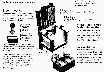
Regarding the quantity of poison used, the article on the gas chamber in
Raleigh (North Carolina) reports that some 454 g of KCN were put into
half-concentrated sulfuric acid, which leads to an instantaneous
development of the gas,
which is even visible for the spectators outside the chamber for a brief
moment and which reaches the victim within seconds.[3]
454 g KCN result in some 180 g of HCN, which corresponds to 150 liters
of gas, of which roughly 50% remain dissolved in the aqueous solution of
sulfuric acid.[6] The remaining 75 liters
of HCN gas develop right underneath the victim in North Carolina's gas chamber.
Hence, the victims is quickly engulfed by high concentrations of HCN,
probably at the beginning as high as 10 vol.-%, although this high
percentage decreases as the gas dissipates throughout the chamber.[7]
Assuming a normal breathing volume of the victim (15
to 20 liters of air per minute) and an average HCN concentration the
victim is exposed to of only 0.75 vol.-%, the victim would have inhaled
some 1.35 to 1.8 grams of HCN within 10 minutes (150-200 ltrs of inhaled
air). This is ten to twenty times the lethal doe for an average human,
which lies at around 1 mg HCN per kg of body weight.[8]
Hence, a fast and certain death of all victims within 15 minutes
obviously requires a ten-fold overdoes of the poison.
An execution procedure using the most modern
execution chamber technology with a lethal gas concentration that should
have killed in only a few seconds was thwarted by at least one intended
victim simply holding his breath. An execution procedure which should have
been painless and quick had proved to be so impractical
that it had been fought legally by its opponents for years and is
now generally abandoned.[9] An execution procedure which dispersed an extremely
lethal concentration of cyanide within seconds and which theoretically
should have killed within a few additional seconds, nonetheless took
eighteen minutes to kill a single, feebleminded victim.
It should now be obvious that the Jewish Holocaust
claims of mass gassings with Zyklon B and CO are rubbish. The sketchy and
error-riddled bits of evidence for those claims show that Nazi gassing
methods were primitive at best.[10]
Rather than dispersing a lethal
concentration in seconds, those methods could have only dispersed
marginally lethal concentrations after many minutes.
Most of the Holocaust executions, more than three
million, were supposedly inflicted with Diesel exhaust. If the Diesels had
been running at idle, even at fast idle, the exhaust would not have been
lethal at all regardless of how long the exposure was; the exhaust would
have contained less than 0.1% CO and about 18% oxygen. But, even with the
engines operating under heavy loads, which in itself is only possible with
the attachment of cumbersome equipment to the engines, the exhaust would
have only been marginally lethal; the exhaust would have contained less
than 0.4% CO and more than 6% oxygen.
For the alleged gassings with cyanide at Auschwitz
and possibly Majdanek, but nowhere else according to the Holocaust story,
the cyanide supposedly arose from granules of Zyklon-B dumped either on
the heads or among the feet of the intended victims or into perforated
columns. For any of those scenarios, the cyanide would have arisen from
the granules slowly; that was after all the whole purpose of Zyklon-B: to
release a measured quantity of cyanide slowly. Under normal conditions a
layer of Zyklon-B 1/2 to 1 centimeter thick would have required
half-an-hour to release half of its cyanide.[11]
The presence of a tightly
packed crowd of intended victims or screening would have slowed the
process even more. Although many might have died within the execution
times that are claimed,[12]
many others would have survived--and that would
have been a fiasco. What would the executioners have done with the
survivors--return them to barracks where they could describe what happened
or send them back in for a second gassing? After separating the obvious
survivors from the dead, how would the executioners identify and dispose
of those who were merely groggy or unconscious or feigning death? The
answer is that any realistic mass gassing arrangement would have had to
kill everyone. Otherwise, one would have had the same emotional strain on
the executioners that supposedly led to mass gassings in the first place
as an alternative to mass shootings.
The American experience with simple gas executions
under ideal conditions proves that mass gassings of Jews would only have
been possible if the Jewish victims--not just some of the Jews, but all--
had assisted in their own mass executions; that is too unbelievable. The
self-assisted Holocaust story is a hoax indeed.
Notes
Updated version as published in German in
Vierteljahreshefte für freie Geschichtsforschung,
1(1) (1997), pp. 6-8.
| [1]
|
A detailed description of the execution was published: Bill
Krueger, "Lawson’s Final Moments," The News & Observer,
Raleigh, North Carolina, June 19, 1994, p. A1.
|
| [2]
|
Newsweek, Nov. 8, 1993, p. 75; The New York Times,
Oct. 6, 1994, p. A20; ibidem, June 16, 1994, p. A23. |
| [3]
|
The News & Observer, Raleigh (NC), June 11, 1994,
p. 14A
(Acc. to the warden usually 10 - 14 min.).
|
| [4]
|
C.T. Duffy, 88 Men and 2 Women, Doubleday, New York
1962, p. 101 (13 - 15 min.); C.T. Duffy was warden of San
Quentin Prison for almost 12 years, during which time he ordered
the execution of 88 men and 2 women, many of them executed in
the local gas chamber.
|
| [5]
|
Stephen Trombley, The Execution Protocol, Crown
Publishers, New York 1992, p. 13 (approximately 10 minutes or more);
Amnesty International, Botched Executions, Fact Sheet
December 1996, distributed by Amnesty International USA, 322 Eighth
Avenue, New York, NY 10001-4808 (more than 7 min)..
|
| [6]
|
See the experiences of G. Rudolf, in:
The Rudolf Report,
Theses & Dissertations Press, Chicago 2003, p. 265.
|
| [7]
|
Assuming a chamber volume of 10 m³, 75 ltrs of HCN equal 0.75
vol.-%.
|
| [8]
|
W. Wirth, C. Gloxhuber, Toxikologie, Georg Thieme
Verlag, Stuttgart 1985, pp. 159f.; W. Forth, D. Henschler, W.
Rummel, Allgemeine und spezielle Pharmakologie und
Toxikologie, Wissenschaftsverlag, Mannheim 1987, pp. 751f.;
S. Moeschlin, Klinik und Therapie der Vergiftung, Georg
Thieme Verlag, Stuttgart 1986, p. 300; H.-H. Wellhöner,
Allgemeine und systematische Pharmakologie und Toxikologie,
Springer Verlag, Berlin 1988, pp. 445f.; F. Flury, F. Zernik,
Schädliche Gase, Dämpfe, Nebel, Rauch- und Staubarten,
Berlin 1931, o. 405; cf. also M. Daunderer, Klinische
Toxikologie, 30. Erg.-Lfg. 10/87, ecomed, Landsberg 1987, pp.
4ff.
|
| [9]
|
See note 2 and Amnesty International, note 5.
|
| [10]
|
See the compilation by
Jürgen Graf,
Auschwitz. Tätergeständnisse und Augenzeugen des Holocaust, Neue
Visionen Schweiz, Postfach, 8116 Würenlos 1994; see also the
quotes and critique in J.-C. Pressac, Auschwitz: Technique and Operation of the
Gaschambers, Beate Klarsfeld Foundation, New York 1989, pp.
124ff., 161f., 174, 177, 181, 229, 239, 379ff., 459-502.
|
| [11]
|
R. Irmscher, "Nochmals: 'Die Einsatzfähigkeit der Blausäure
bei tiefen Temperaturen,', Zeitschrift für hygienische
Zoologie und Schädlingsbekämpfung, 1942, p. 36.
|
| [12]
|
With relation to the killing times, see in, for example:
Schwurgericht Hagen, verdict from July 24, 1970, ref. 11 Ks
1/70, p. 97 (5 min.); Final Trial Brief of the Prosecution,
quoted acc. to U. Walendy, Auschwitz im IG-Farben-Prozeß,
Verlag für Volkstum und Zeitgeschichtsforschung, Vlotho 1981,
pp. 47-50 (3 to 15 minutes in extreme cases); E. Kogon, H.
Langbein, A. Rückerl et al. (eds.), Nationalsozialistische
Massentötungen durch Giftgas, S. Fischer Verlag, Frankfurt
1983, ubiquitous (immediately up to 10 min., more rarely, up to
20 min.); J. Buszko (ed.), Auschwitz, Nazi Extermination Camp,
Interpress Publishers, Warschau 21985, in cooperation with the
Auschwitz State Museum, pp. 114 + 118 (a few minutes); H.G.
Adler, H. Langbein, E. Lingens-Reiner (ed.), Auschwitz,
Europäische Verlagsanstalt, Cologne 31984, pp. 66, 80 + 200 (a
few minutes, up to 10 minutes); Hamburger Institut für
Sozialforschung (ed.), Die Auschwitz-Hefte, vol. 1, Beltz
Verlag, Weinheim 1987, pp. 261ff. +294 (instantly, up to 10
min.); C. Vaillant-Couturier, in: IMT, vol. VI, p. 242 (5
to 7 min.); M. Nyiszli in: G. Schoenberner (ed.), Wir haben
es gesehen, Fourier, Wiesbaden 1981, p. 250 (5 min.); C.P.
Bendel in: H. Langbein, Menschen in Auschwitz,
Europaverlag, Vienna 1987, p. 221 (end of screaming of victims
after 2 min.); P. Broad in: B. Naumann, Auschwitz,
Athenäum, Frankfurt/Main 1968, p. 217 (4 min.), opening of doors
after 10-15 minutes: A. Rückerl, NS-Verbrechen vor Gericht,
C.F. Müller, Heidelberg, 21984, pp. 58f.; K. Hölbinger in: H.
Langbein, Der Auschwitz-Prozeß, Europäische
Verlagsanstalt, Frankfurt/Main 1965, p. 73 (1 min.): R. Böck,
ibid., p. 74 (screaming victims for 10 minutes following closure
of doors, followed by opening of doors, cf. note 297); K.
Höblinger, ibid., p. 73 (1 min.); H. Stark, ibid., p. 439 (screaming
victims for 10-15 minutes); F. Müller, ibid., p. 463 (8-10
min.); E. Pyš, ibid., p. 748 (ventilators switched on after only
a few minutes); K. Lill, ibid., p. 750 (a scream a few seconds
after the introduction of Zyklon B, pall of thick smoke exiting
the chimney a few minutes later); transcript of the expert
opinion of Prof. Dr. G. Jagschitz, 3rd-5th hearing days of
criminal proceedings against Gerd Honsik, April 4., April 30,
May 4, 1992, ref. 20e Vr 14184 and Hv 5720/90, District Court
Vienna, p. 443 (2-3 min); Dokument 3868-PS, IMT volume 33, pp.
275ff., quoted according to L. Rosenthal, “Endlösung der
Judenfrage”, Massenmord oder “Gaskammerlüge”?, Verlag
Darmstädter Blätter, Darmstadt 1979 (2 to 15 minutes in
exceptional cases); R. Höß, M. Broszat (ed.), Kommandant in
Auschwitz, Deutsche Verlags-Anstalt, Stuttgart 1958 (30
minutes for the entire procedure, including ventilation); Hans
Münch, in G. Rudolf, “Auschwitz-Kronzeuge Dr. Hans Münch im
Gespräch”, Vierteljahreshefte für freie Geschichtsforschung,
1(3) (1997), pp. 139-190 (2 to 5 min. in winter) (online:
www.vho.org/VffG/1997/3/RudMue3.html); Salmen Lewenthal,
Hefte von Auschwitz, Sonderheft 1, Handschriften von
Mitgliedern des Sonderkommandos, Verlag Staatliches Museum
Auschwitz, 1972, p. 155 (sudden silence); Dov Paisikovic, in:
Léon Poliakov, Auschwitz, René Julliard, 1964, pp. 159ff.
(3-4 minute), Franke-Gricksch Report, in: J.-C. Pressac,
Auschwitz: Technique and Operation of the Gas Chambers,
Beate-Klarsfeld-Foundation, New York 1989, p. 238 (one minute to
kill the victims, another until the doors were opened); Rudolf
Vrba alias Walter Rosenberg, Alfred Wetzler, ref. M 20/153, Yad
Vashem (acc. to War Refugee Board, “German Extermination
Camps—Auschwitz and Birkenau”, in David S. Wyman (ed.),
America and the Holocaust, volume 12, Garland, New
York/London 1990, p. 20 (everyone in the room was dead after
three minutes); Jerzy Tabeau, in: The Extermination Camps of
Auschwitz (Oswiecim) and Birkenau in Upper Silesia (10
minutes, quoted according to Enrique Aynat, Los protocolos de
Auschwitz. i Una fuente historica? Garcia Hispan, Alicante
1990); André Lettich, Trente-quatre mois dans les Camps de
Concentration, Imprimerie Union Coopérative, Tours, 1946 (a
few moments). Janda Weiss, in David E. Hackett, (ed.), The
Buchenwald Report, Beck, Munich 1997, p. 394 (3 min.). If
longer killing times appear in the eyewitness testimonies, they
refer not to crematoria II and III, but rather to crematoria IV/V,
bunkers 1-2, or crematorium I in the Main Camp. The killings in
crematoria II and III are therefore alleged to have been
committed very quickly. |
|